







300 kVA 11/0.415 kV Oil-Immersed Distribution Transformer Guide
Oct 29, 2025
Leave a message
The Role of the 300 kVA Distribution Transformer
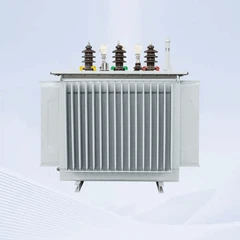
A 300 kVA oil-immersed distribution transformer steps down a medium-voltage feeder, typically 11 kV, to a low-voltage supply of 0.415 kV for local distribution. Units of this capacity are widely used for rural electrification programmes, small towns and villages, agricultural processing centres, schools and clinics, and light industrial estates, where the connected load is larger than a pole-mounted single-phase supply can serve but the site does not justify a major substation. The transformer is designed and tested in accordance with IEC 60076, and in the common sealed-tank configuration the oil is protected from the atmosphere so that the insulation ages more slowly and the maintenance requirement stays low.
Typical Technical Specifications
The table below lists the parameters that define a 300 kVA 11/0.415 kV distribution transformer. These are representative values; the exact figures are fixed by the project specification and the efficiency class required by the local regulation.
| Parameter | Typical Value |
|---|---|
| Rated power | 300 kVA |
| Frequency | 50 Hz |
| Phase | Three-phase |
| Primary voltage | 11 kV |
| Secondary voltage | 0.415 kV |
| Vector group | Dyn11 |
| Impedance voltage | 4% |
| No-load loss | Approximately 0.48 kW |
| Load loss | Approximately 3.65 kW |
| Cooling type | ONAN |
| Tap changer | Off-circuit, plus or minus 2 by 2.5% |
Sealed-Tank Design and Its Benefits
Many 300 kVA distribution transformers are built as hermetically sealed units without a conservator. In this design the tank is completely filled with oil and closed, so the oil cannot absorb moisture from the atmosphere and does not oxidise as quickly as in a breathing design. The result is slower insulation ageing, a more stable dielectric strength, and a longer service life, which is particularly valuable in hot and humid climates. The sealed tank also simplifies installation, because no conservator, breather, or oil expansion system needs to be commissioned. The standard fittings on this class of unit include an oil level indicator, a drain and sampling valve, a pressure relief device, and lifting lugs, with a Buchholz relay available where the specification requires additional protection.
Design and Construction Features
The core is built from cold-rolled grain-oriented silicon steel, and the windings are copper conductors arranged in concentric layers with oil ducts for cooling. The high-voltage winding is connected in delta and the low-voltage winding in star with an accessible neutral, giving the Dyn11 vector group that suits 400 V distribution systems with a four-wire low-voltage network. The tank is made of welded steel with corrugated or finned walls that increase the cooling surface, and it is finished with a corrosion-resistant paint system for outdoor installation. The transformer is designed for outdoor mounting on a plinth, with the high-voltage side protected by fuses or a load-break switch in the upstream network and the low-voltage side feeding a distribution board through a metering point.
Applications and Site Considerations
The 300 kVA rating serves a compact zone of supply: a small town district, a group of villages, an agricultural processing plant, or a medium commercial complex. The installation site must provide a level foundation, adequate clearance around the tank, and protection from flooding. The earthing of the tank and the neutral must follow the local regulations, and the low-voltage protection must be coordinated with the transformer impedance and the expected fault level. Before energisation, the oil level, the tap position, and the connections are checked, and the routine test report is reviewed. The unit is designed for continuous operation in ambient temperatures from roughly -25 C to +40 C and at altitudes up to 1,000 m, with derating required at higher altitudes.
FAQ
Q: What does 11/0.415 kV mean on the nameplate?
A: It states the voltage ratio: the primary winding is rated for an 11 kV system and the secondary delivers 0.415 kV phase to phase at no load. The phase-to-neutral secondary voltage is 0.415 kV divided by the square root of three, approximately 240 V.
Q: What is the advantage of the Dyn11 vector group?
A: Dyn11 means the high-voltage winding is delta-connected and the low-voltage winding is star-connected with the neutral brought out. The delta connection reduces the third-harmonic voltages, and the accessible star neutral provides the reference for the 400 V four-wire distribution system.
Q: What is an off-circuit tap changer used for?
A: It adjusts the turns ratio to compensate for a consistently high or low primary voltage. The taps are changed only with the transformer de-energised, and the standard range is plus or minus 2 by 2.5% around the nominal ratio.
Q: How often does a sealed transformer need oil maintenance?
A: Because the sealed tank excludes moisture and oxygen, the oil can remain in service for many years. A periodic oil sample for dielectric strength and moisture is still recommended, typically every three to five years, and more frequently if the unit has been opened for repair.
Q: Can the transformer be pole-mounted?
A: A 300 kVA unit is too heavy for a conventional single-pole mounting in most cases. It is normally installed on a plinth or a two-pole platform with a suitable lifting arrangement, and for smaller loads the same manufacturer family offers pole-mounted units up to about 100 kVA.
Q: Which standard applies to the 300 kVA unit?
A: The transformer is manufactured and tested in accordance with IEC 60076 and the equivalent national standard GB 1094. The efficiency class is declared against the applicable local regulation, such as GB 20052 in China or the ecodesign requirements in the European Union.
Send Inquiry