What is Oil Immersed Transformer


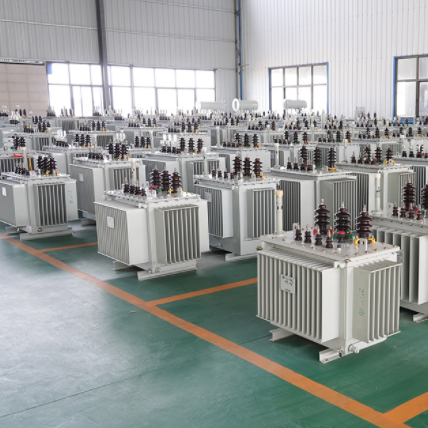
An oil-immersed transformer, also called Oil filled transformer, is a kind of voltage transformation device utilizing the oil cooling method to reduce the transformer temperature. Unlike the dry type transformer, the body of the Oil-immersed transformer is installed in the welded steel oil tank filled with insulation oil. When an Oil-immersed transformer in operation, the heat of the coil and iron core firstly is transformed into the insulation oil and then to the cooling medium. And according to the capacity sizes, it can be divided into an immersed natural cooling transformer and an immersed forced air cooling transformer.

Request a Full Catalog


GNEE Exhibition Photo Gallery
 

Exhibition Photo Gallery

Contact With GNEE Today

First 1234567 Last

Get Best Price →

GNEE Customer Visit

custormer visit

Why Choose GNEE Electric?


Choosing the right transformer supplier is not just about price — it’s about long-term reliability, safety, and partnership. At GNEE Electric, we combine engineering expertise, strict quality control, and global export experience to deliver oil-immersed transformers you can truly depend on.


1. Proven Manufacturing Strength

With advanced production lines and a well-established quality management system, we ensure every oil-immersed transformer meets international standards such as IEC, ANSI, and GB. Each unit undergoes comprehensive routine and type testing before delivery.


2. Strict Quality Control from Core to Final Assembly

From silicon steel core selection to winding insulation, oil filling, and final testing — every process is carefully monitored. We use high-grade raw materials to guarantee stable performance, low loss, and extended service life.


3. Customized Solutions for Different Markets

Voltage levels, frequency, temperature rise limits, cooling methods, special protection requirements — we tailor our transformers to meet your local grid standards and project specifications. OEM & ODM services are available.


4. Energy-Efficient & Cost-Effective Designs

Our oil-immersed transformers are engineered for low no-load loss and reduced operating costs, helping customers save energy and maximize return on investment over the equipment’s lifecycle.


5. Fast Delivery & Stable Supply Chain

With strong production capacity and efficient supply chain management, we ensure on-time delivery even for bulk orders.


6. Professional Export Experience

We have extensive experience serving clients across Asia, Africa, the Middle East, and South America. Our team understands international project requirements, documentation standards, and shipping procedures.


7. Responsive Technical Support

From pre-sales consultation to after-sales service, our engineering team provides prompt technical assistance to ensure smooth installation and long-term operation.


Looking for Transformer? Order Now


Dry Type Transformer vs Oil Type Transformer: Comparing the Differences
 
1. Cooling Medium: Air vs. Oil

Dry-Type Transformers: The reliance on air for cooling in dry-type transformers makes them inherently efficient in dissipating heat. Air is readily available and serves as a cost-effective cooling solution. This efficiency has limits, restricting the voltage capacity of dry-type transformers to around 35kV due to cooling constraints.
Oil-Filled Transformers:As the transformer's internal components heat up during operation, the heat is transferred to the insulating oil, dissipating it efficiently. This allows oil-filled transformers to handle higher voltage levels and offers superior performance in demanding environments.

2. Maintenance: Regular Care vs. Infrequent Attention

Dry-Type Transformers: One of the advantages of dry-type transformers is their resilience and reduced need for regular maintenance. These transformers are inherently less prone to issues caused by oil degradation, such as chemical contamination. Dry-type transformers often require less frequent maintenance checks, saving time and resources.
Oil-Filled Transformers: Transformers filled with oil demand more attention. The oil used for cooling and insulation needs regular monitoring to ensure its quality and effectiveness. Periodic testing for chemical contamination and scheduled oil filtration is essential to maintain optimal performance and extend the transformer's lifespan.

3. Operational Costs: Energy Efficiency vs. Operational Expenditure

Oil-Filled Transformers: Oil-immersed transformers might incur higher initial costs due to the oil's involvement and the associated safety measures required for outdoor installations.these costs are often offset by the transformers' energy efficiency. The efficient cooling provided by oil contributes to better heat dissipation, reducing energy losses and operational expenses over time.
Dry-Type Transformers: Although dry-type transformers typically have lower initial costs and require less maintenance, their energy efficiency might differ from their oil-filled counterparts. The air-based cooling mechanism, while efficient, might lead to slightly higher energy consumption in the long run.

4. Environmental Impact: Comparing Footprints

Dry-Type Transformers: Dry-type transformers stand out for their environmentally friendly nature. The absence of oil eliminates the risk of oil leaks and spills, reducing the potential environmental harm. This makes them a preferred choice for indoor installations and settings where ecological impact is a significant concern.
Oil-Filled Transformers: While oil-filled transformers offer exceptional, their reliance on oil introduces a potential environmental hazard. The risk of oil leaks and the need for oil containment measures make them better suited for outdoor installations where ecological protection measures can be more effectively implemented.


500KVA 416KV 3 Phase Oil-immersed Outdoor Transformer


The role of transformer oil in oil-immersed transformers

Insulation. The first function of oil-immersed transformer oil is insulation, and the insulation strength of transformer oil is much higher than that of air. The insulating material is soaked in oil, which can not only improve the insulation strength, but also protect it from the erosion of moisture.


Heat dissipation. The second function of transformer oil is heat dissipation. The transformer oil of the oil-immersed transformer has a large specific heat and can be used as a coolant. The heat generated during the operation of the transformer can cause the oil close to the iron core and winding to expand and rise. Through the convection of the oil up and down, the heat is dissipated through the radiator to ensure the normal operation of the transformer.


Arc suppression. The third role of transformer oil in oil-immersed transformers is arc suppression. On oil circuit breakers and on-load tap taps for transformers, arcing occurs when the contacts switch. Transformer oil has good thermal conductivity. Under the high temperature of the arc, it will decompose a large amount of gas and generate a large pressure, which improves the arc extinguishing performance of the medium and makes the arc extinguish quickly.


Structure and operation principle of Oil-immersed transformer

An Oil-filled transformer is structurally similar to that of a transformer. It's one of the types of transformers classified according to the form of core insulation.it has the identifiable feature of oil-immersed coils to lower the heat map of the devices within it.
The basic elements of an oil-immersed are consist of the magnetic core, windings, and bushings. The magnetic core provides a path for magnetic flow. Windings create a magnetic field and consist of a conductor coil, wrapped around the core and insulated with pressboard barriers and screens. The thickness of the winding insulation increases with voltage. Bushings connect transformer windings to a substation.
Oil-type transformers are used in power distribution or electrical substations. Their core and coils are immersed in Oil, which cools and insulates. Oil circulates through ducts in the coils and around the coils and core assembly, moved by convection. The Oil is cooled by the outside of the tank in small ratings, and by an air-cooled radiator in larger ratings.

1000kVA oil-immersed transformer
2500KVA 10 04KV Oil distribution transformers


Types of Oil-Filled Transformers

Single-phase transformers use one pair of windings. It's used in lower-load situations, such as rural areas.
Three-phase transformers are made up of three pairs of windings. The windings typically go around a core sectioned into three parts. Three-phase transformers are used in higher-load areas and can supply three circuits with energy.
Power transformers are designed to handle much higher loads. They can step voltages up or down and transmit a current from one place to another.
Distribution transformers transmit lower voltages from the electrical grid to homes and businesses. They are much smaller than power transformers.
Pole-mounted transformers are connected to an electrical pole.
Pad-mounted transformers are mounted to a concrete pad on the ground.

How to perform routine maintenance on oil-filled transformers

Oil and temperature

To perform daily checks on the transformer's temperature, we must inspect the ambient, oil, and winding temperatures and compare them against rated values. The oil level gauge indicator should vary with temperature changes, and if the oil level gauge is of a magnetic model, the indicator should rotate in the presence of a test magnet. If the indicator does not respond in either case, then the indicator must be replaced.

ElectricalPerformance

To perform daily checks to evaluate the transformer's electrical performance, we must inspect the load voltage and current values and compare them against the rated figures. The load settings dictate which type of transformer can be used to feed it. Due to its importance, a transformer is often protected by differential, overcurrent, and ground-current relays that must be monitored and maintained daily. Using the wrong transformer and not maintaining protective relays can cause electrical damage and electrical failure of the equipment, respectively.

Noise level

It is a more prominent performance indicator for dry-type transformers.the noise level emitted by an oil-filled transformer's coils, core, and cooling system might also be used to evaluate its performance. If an oil-filled transformer emits loud noises during operations, then it is important to promptly identify the source of the noise and measure it through the following three techniques.


What Are The Steps To Keep An Oil-Filled Transformer Running Smoothly

Step 1. To isolate the low-voltage side of the oil filled transformer, you'll need to hang a matching nameplate from the draw handle and flip the switch.


Step 2. Make sure the load switch is not connected to the voltage side of the oil filled transformer and the grounding is generally disengaged before turning on the power.


Step 3. Remove the high-voltage knife, and inspect the shell, porcelain, and lead wire with an electroscope.


Step 4. The oil filled transformer porcelain, loss of heat, and cleaning systems all need to be thoroughly checked and maintained regularly.


Step 5. When maintaining an oil filled transformer, it is essential to inspect the voltage side load switch for proper operation and transmission-part lubrication.

productcate-459-420


6 Signs You Need to Replace Your Oil-Filled Transformer


DGA Oil Tests
Gases within a transformer can be the result of a breakdown of the materials the transformer is made up of. This can provide valuable insight into the health of your transformer. Depending on which gases within your transformer are revealed to be high, it may be time to replace your transformer.


Infrared Scans
Much like an X-ray at the doctor's office can illustrate problems in your body, a scan of your transformer can provide similar, analogous information. An infrared scan of your transformer can allow you to take note of any bushing or connections that might be running hot.


Leaks
Leaks can usually be repaired, but sometimes, an onslaught of leaks can be indicative of a larger problem at play. If you are consistently spending money repairing leaks in your transformer, it may be a sign that a larger failure is on its way. You can avoid the massive financial loss of a transformer failure by replacing it before it's too late.


Noise & Vibration
Transformers are similar to cars in that if they sound broken, that's a safe bet that it's worth looking at. Sound as a performance indicator is more relevant to dry-type transformers,if your oil-filled transformer is one of the loudest noisemakers of your infrastructure, you should investigate its health and performance.


Old, Flaking Paint
Believe it or not, this simple cosmetic indicator could be a sign that your transformer is on its last leg. A transformer that is near failure and needs to be replaced will often run hot. A symptom of this is that it may warp the exterior paint, or cause it to start to flake.if you have a 25-year-old transformer with a few paint chips, don't be too alarmed, but if consistent paint damage is happening alongside other warning signs, it may be time to reach out for a replacement.


Color
Look at the color of the oil your transformer contains. If it is black or dark in color, that is a sign that it took a hit or surge. If your transformer underwent this level of strain, it's a safe bet that it is simply limping along, and looking into a replacement might will you avoid total failure.


productcate-479-423


How Does An Oil Immersed Transformer Work

There is an iron core in the oil immersed transformer, and two mutually insulated windings are wound around the iron core.
The side connected to the power supply is called the primary winding, and the side that outputs electrical energy is called the secondary winding.
When the AC power supply voltage is applied to the primary side winding, an AC current flows through the winding, and an alternating magnetic flux is generated in the iron core.
This alternating magnetic flux not only passes through the primary winding, but also passes through the secondary winding, and induced potentials E1 and E2 are generated in the two windings respectively.
The ratio of the induced electromotive force on the primary and secondary sides of the transformer is equal to the ratio of the turns of the primary and secondary side windings.
When the number of turns of the primary and secondary windings of the transformer is different, the voltage can be transformed.
Compared with ordinary transformers, the cooling method is slightly different.
During the operation of oil-immersed power transformers, the heat of the windings and iron cores is first transferred to the oil, and then to the cooling medium through the oil.


Our transformers


Iron core

The core is cold rolled silicon steel sheet with high permeability magnetic grain orientation. The iron core is a core type iron core, the full oblique joint stacking type iron core, the iron core column is a multi-step circular cross-section, the iron bar and the iron core are equal cross-section.


winding

The winding adopts corrugated oil channel, no paint dipping process, and tight tape binding; The windings are concentric coils: the high voltage winding has a tap required for the tap voltage, which is led to the tap switch, the switch is installed on the box cover, and the voltage transfer of 10kV and 20KV can be achieved after the power is cut off, and the tap voltage is changed.


Safety protection device

30~2000kVA transformer equipped with pressure relief valve:

Gas relays with alarm and tripping terminals can be installed according to user requirements;


our factory


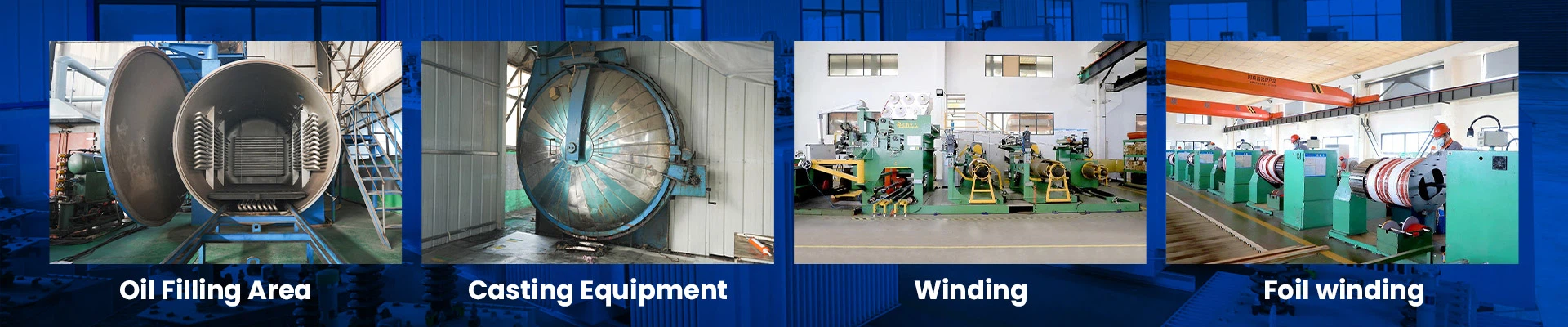
At GNEE Electric, our factory is the foundation of our product quality and delivery reliability. Equipped with advanced production facilities and strict quality management systems, we manufacture oil-immersed transformers that meet international standards and demanding project requirements.


Modern Production Facilities

Our workshop is equipped with automated core cutting machines, precision winding equipment, vacuum oil filling systems, and high-voltage testing instruments. Every production step — from silicon steel core assembly to final inspection — is carried out under strict technical control.


Strict Quality Management

Quality is built into every stage of production. We implement systematic inspection procedures covering raw material testing, in-process inspection, routine testing, and final performance verification. Each transformer undergoes comprehensive electrical tests before shipment to ensure safety, stability, and long service life.


Strong Manufacturing Capacity

With optimized production processes and skilled technical teams, our factory maintains stable output and efficient order management. Whether for small batch customization or bulk project supply, we ensure consistent quality and on-time delivery.


Skilled Engineering Team

Our experienced engineers and technicians continuously improve production efficiency and product performance. Through ongoing technical innovation, we enhance energy efficiency, reduce losses, and extend equipment lifespan.


Commitment to Continuous Improvement

Guided by the philosophy of continuous progress, we invest in equipment upgrades, workforce training, and process optimization to maintain competitiveness and meet evolving global market demands.

productcate-468-468
productcate-461-461
productcate-509-509
productcate-512-512
productcate-339-339
productcate-429-429
productcate-428-428
productcate-363-363
 
FAQ
 

Q: What is the purpose of the oil-immersed transformer?

A: The first function of oil-immersed transformer oil is insulation, and the insulation strength of transformer oil is much higher than that of air. The insulating material is soaked in oil, which can not only improve the insulation strength, but also protect it from the erosion of moisture.

Q: What is the maintenance of an oil-immersed transformer?

A: The tasks to include in your yearly oil-immersed transformer maintenance plan include: Inspect the temperature indicators and off-circuit selector, and replace them if necessary. Check the weatherproof seals on the marshaling boxes. Measuring the insulation resistance of the transformer's protection relays.

Q: How much can you overload an oil filled transformer?

A: The maximum overload of the transformer shall not exceed 50% of the rated load; In case of system failure, the primary task is to ensure uninterrupted power supply, while the aging acceleration of transformer insulation is secondary, and the accidental overload is at the expense of transformer life.

Q: When a transformer is often filled with oil the oil used should have?

A: Transformer oil's primary functions are to insulate and cool a transformer. It must therefore have high dielectric strength, thermal conductivity, and chemical stability, and must keep these properties when held at high temperatures for extended periods.

Q: Which is better oil immersed or dry type transformer?

A: Oil transformers place the iron core and winding inside an oil tank filled with transformer oil, whereas dry transformers often encapsulate the iron core and winding with epoxy resin or use non-encapsulated types with impregnated insulation to prevent moisture.

Q: What is the main cause of deterioration of transformer oil?

A: The most predominant factors responsible for causing deterioration of transformer oil and subsequently failure of transformers are:
Development of internal pressure in the oil.
The rise in temperature during operating conditions.
Frequent change in operating voltage levels.

Q: How often should transformer oil be changed?

A: However, as a general guideline, insulating oil samples should be taken and tested at least every five years to assess the condition of the insulating oil. Only this assessment determines the need for a change and helps to save costs.

Q: What causes transformer oil leakage?

A: Some transformers have defects, such as poor welding, insufficient sealing, or loosely torqued bolts. These defects can cause oil leaks. Even in brand new transformers.

Q: How far should an oil filled transformer be from a building?

A: Combustible/Non-combustible construction type shall be that which is defined by respective state building codes. A. Doors, Fire Escapes, or Fire Exits. Padmounted transformers shall not be located within a zone extending outward 20 feet and 10 feet to the side from any doorway, fire escape, or fire exit.

Q: What are the signs of an overloaded transformer?

A: If the power consumption is greater than information listed on the nameplate, there's likely an overload.

Q: Can oil filled transformers be located indoors?

A: (a) Indoor Installations. Oil-insulated transformers shall not be installed indoors except in a vault constructed in accordance with Sections 2805 and 2806, or a separate building meeting the requirements of Section 2807.
(b) High Fire Point Liquid-Insulated Transformers.

Q: How often should transformer oil be filtered?

A: Routine oil sampling and testing can guide the need for filtration or replacement. If the tests indicate degradation, filtration might be performed annually or as recommended by experts. Complete oil replacement might occur every 5-10 years based on the transformer's condition, although this can vary significantly.

Q: What is the permissible overload percent for oil immersed transformers?

A: The maximum overload of the transformer shall not exceed 50% of the rated load; In case of system failure, the primary task is to ensure uninterrupted power supply, while the aging acceleration of transformer insulation is secondary.

Q: What are the two types of cooling in oil immersed power transformer?

A: There is a wider range of cooling methods for oil-type transformers.
(Mineral) Oil Natural Air Natural (ONAN) – The core and coils are cooled by surrounding in oil.
(Non-Mineral) Oil Natural Air Natural (KNAN) – The core and coils are cooled by surrounding in synthetic oil.

Q: What is the difference between dry type transformer and oil immersed transformer?

A: Dry-type transformers use air as the cooling medium, while oil-filled transformers use oil instead of air. Some public places do not use oil-filled transformers because they are considered to be a big fire hazard and, instead, use dry-type transformers.

Q: How close can an oil filled transformer be to a building?

A: Non-combustible walls: Padmount oil-insulated transformers may be located next to non-combustible walls if the following clearances are maintained from windows, doors or other openings 20' outward and 10' on either side.

Q: What is the fire protection for oil immersed transformer?

A: NFPA 850, Recommended Practice for Fire Protection for Electric Generating Plants and High Voltage Direct Current Converter Stations, recommends that transformers with more than 500 gallons (1900 L) of oil be protected by a fire wall rated for 2 hours that is extended 1ft (300 mm) vertically and 2ft (600 mm)

Q: What do oil immersed transformers have for the safety of transformer?

A: Important protective devices/ schemes for oil filled transformers are:
Buchholz relay
Pressure relief device (or explosion vent)
Differential protection
Winding temperature and oil temperature alarm and trip arrangement
Oil level alarm and trip arrangement.

Q: What does Buchholz relay in oil immersed transformer provide?

A: It is a gas and oil-operated relay that provides protection against internal faults in the transformer such as insulation breakdown, core faults, and overheating.

Q: What are the cooling methods for oil immersed transformers?

A: Oil-type transformers are cooled using oil-air cooling or oil-water cooling method. There is a wider range of cooling methods for oil-type transformers. (Mineral) Oil Natural Air Natural (ONAN) – The core and coils are cooled by surrounding in oil. Heat transfer of oil by natural air convection.

Henan GNEE Electric Co., Ltd. is well-known as one of the leading oil immersed transformer manufacturers and suppliers in China. Please feel free to wholesale cheap oil immersed transformer in stock here from our factory. Quality products and low price are available.

Dry Type Power Transformer Substation, 11kV Three Phase Oil Immersed Distribution Transformer, Amorphous Metal Core Transformer

Send Inquiry