







Low-Voltage Winding Conductor Transposition Technology: How to Reduce Eddy Current Loss of 2000kVA Oil-Immersed Transformers
At GNEE, a specialized factory of power transformer manufacturing heritage, we integrate low-voltage winding conductor transposition technology as a standard feature in all high‑capacity units. This advanced winding technique is the single most effective engineering measure to slash the eddy current loss of a 2000kVA oil‑immersed transformer, directly improving efficiency, lowering hot‑spot temperatures, and extending operational life.
Click To Secure Your 2000kVA Oil‑Immersed Transformer
As an ISO 9001‑certified producer shipping to over 150 countries, GNEE understands that in a 2000kVA machine, even a fractional percentage of stray loss translates into significant kilowatts of wasted energy and unnecessary cooling demand. By controlling the way individual conductors are arranged and transposed inside the low‑voltage winding, we give distribution networks and industrial users a measurable edge in both energy performance and reliability.

GNEE transformer winding workshop
Whether you are designing a new substation, upgrading an industrial power plant, or specifying an energy‑saving retrofit, the way eddy currents are managed inside the LV winding directly determines the long‑term operating cost of your 2000kVA oil‑immersed transformer.
This article explains the technology, quantifies its benefits, and shows why a GNEE‑built transformer with transposed LV conductors is the logical choice for modern power systems.
Why Eddy Current Loss in a 2000kVA Oil‑Immersed Transformer Must Be Controlled
Every 2000kVA oil‑immersed transformer carries large currents in its low‑voltage winding-often up to 2,900 A at 0.4 kV. Such heavy current generates an intense alternating leakage magnetic field that intersects the winding conductors themselves. According to Lenz's law, this induces eddy currents within each conductor, creating additional resistive losses that manifest as heat.
In a conventional 2000kVA oil‑immersed transformer without effective conductor transposition, these eddy current losses can consume an extra 8 % to 15 % of the basic DC copper loss, directly increasing the winding temperature and accelerating cellulose insulation aging.
For a 2000kVA oil‑immersed transformer operating continuously, every kilowatt of avoided eddy current loss represents approximately 8,760 kWh saved per year.
At industrial energy tariffs, this translates into substantial financial savings and a measurable reduction in carbon footprint. More critically, the hotspot temperature inside the LV winding is the dominant factor determining insulation life. By controlling eddy current loss at the source, the expected service life of the 2000kVA oil‑immersed transformer can be extended well beyond the standard 25‑year benchmark.
That is why leading manufacturers, including GNEE, invest heavily in precise conductor transposition techniques.
What Is Low‑Voltage Winding Conductor Transposition Technology?
Low‑voltage winding conductor transposition technology is a precision winding method in which the individual parallel strands making up a single LV turn are periodically exchanged in radial position as the coil is wound. In a 2000kVA oil‑immersed transformer, the LV winding commonly comprises multiple rectangular copper or aluminum strips stacked in parallel to handle the high current. If these parallel strands remain in fixed radial positions from top to bottom, each strand links a slightly different amount of leakage flux. The resulting unequal electromotive forces drive circulating currents between strands-a major component of the total eddy current loss.
Conductor transposition solves this by systematically rotating the positions of the strands so that, over the full winding height, every strand occupies every radial slot for an equal distance. This equalizes the flux linkage across all parallel paths and virtually eliminates the intra‑turn circulating current loss.
At GNEE, we apply a specialized basket‑type transposition for our 2000kVA oil‑immersed transformers, where the bundle of strips is folded and crossed at predetermined intervals. The result is a tightly wound, mechanically stable LV coil in which the residual eddy current loss originates only from the skin effect within the individual strand itself-a quantity that is controlled by strand thickness selection.
✅️Key Stages of Conductor Transposition in a 2000kVA Oil‑Immersed Transformer LV Winding
To achieve a flawless transposition, GNEE follows a rigorously defined process:
- Strand dimension optimization – selecting strand thickness below twice the skin depth at 50/60 Hz to keep the per‑strand eddy loss negligible.
- Enamel and paper insulation – applying a proven inter‑strand insulation system that survives bending during transposition and maintains dielectric strength.
- Pre‑bending and grouping – mechanically forming strands into bundles and pre‑shaping them so that the cross‑over points sit precisely at the intended axial heights.
- Continuous wrap transposition – winding the LV coil on a mandrel while executing transpositions at every 10 % – 15 % of the overall winding height, ensuring equalized flux linkage without adding excessive mechanical stress.
- Post‑winding dimensional control – verifying radial build and transposition symmetry using laser measurement before the coil goes into the core assembly.
How Low‑Voltage Winding Conductor Transposition Reduces Eddy Current Loss in Practice
The physics behind the loss reduction are straightforward. When parallel strands are transposed, the net electromotive force acting around any closed loop formed by two strands becomes nearly zero.
In a 2000kVA oil‑immersed transformer where GNEE has implemented full transposition, the circulating current component of the eddy current loss typically drops to less than 3 % of the DC loss, compared to 10 % – 15 % in untransposed designs. This directly lowers the total load loss, improves voltage regulation, and reduces the heat that must be dissipated through the oil.
Even when compared with a partially transposed design-where transpositions are made only at the winding center or ends-a fully transposed 2000kVA oil‑immersed transformer shows a measurable advantage. Partial transposition leaves residual circulating currents because the winding height is split unequally. GNEE's engineering calculations, validated by IEC 60076 type tests, confirm that only a regular pattern of multiple transpositions over the total coil length can approach the ideal equal‑flux condition. This is the design philosophy built into every GNEE 2000kVA oil‑immersed transformer.
GNEE's Factory Application of Conductor Transposition in 2000kVA Oil‑Immersed Transformer Manufacturing
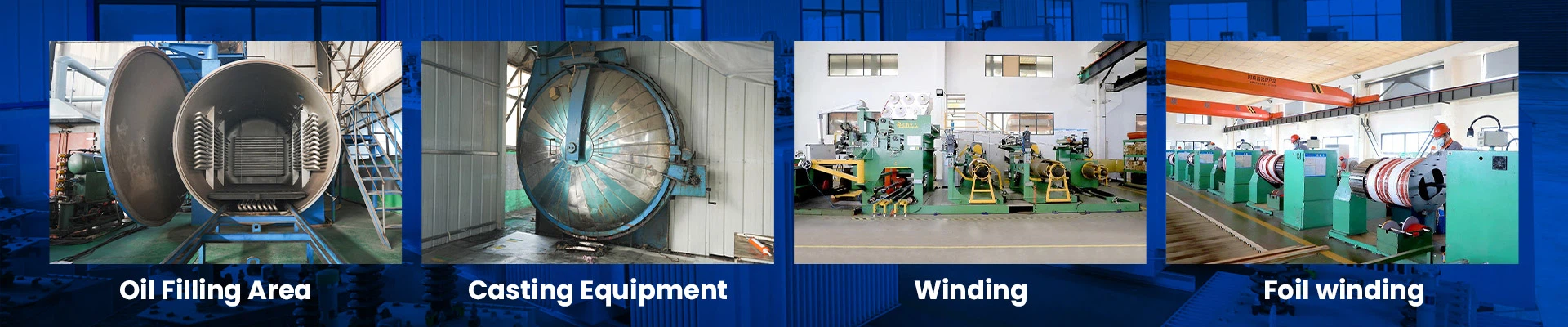
As a direct manufacturer, GNEE controls the entire production chain of the 2000kVA oil‑immersed transformer. Our winding shop is equipped with horizontal winding machines capable of handling the wide, multi‑strand conductors required for high‑current LV coils. The transposition stations are set up with purpose‑built bending jigs that ensure a consistent cross‑over radius without damaging the paper insulation. Each coil is subjected to an inter‑strand insulation test before and after winding, confirming that the transposition process has not compromised dielectric integrity.

Our quality assurance extends beyond the coil stage. The completed 2000kVA oil‑immersed transformer undergoes a full‑load loss test together with a stray loss measurement using the short‑circuit method, carried out in our in‑house 6,000 kVA test station. The results are compared with finite‑element‑analysis predictions to verify that the achieved eddy current loss falls within the targeted band. Only after passing this test is the transformer moved to the tanking and oil‑filling line. By maintaining this discipline, GNEE guarantees that every 2000kVA oil‑immersed transformer fitted with low‑voltage conductor transposition delivers its promised efficiency from day one.
Parameters and Performance Comparison: Transposed vs. Non‑Transposed LV Winding
The following table compares the typical performance parameters of a 2000kVA oil‑immersed transformer supplied with a fully transposed LV winding against an equivalent unit built without conductor transposition. All values refer to ONAN cooling, 10 kV/0.4 kV, 50 Hz, based on GNEE's standard design portfolio.
| Technical Parameter | Without LV Conductor Transposition | With Full LV Conductor Transposition (GNEE Standard) |
|---|---|---|
| Rated Power | 2000 kVA | 2000 kVA |
| HV / LV Voltage | 10 kV / 0.4 kV | 10 kV / 0.4 kV |
| DC Loss (LV) | 7.8 kW | 7.8 kW |
| Additional Eddy & Stray Loss (LV) | 1.05 kW (13.5 % of DC) | 0.22 kW (2.8 % of DC) |
| Total Load Loss (75 °C) | 14.9 kW | 13.7 kW |
| Efficiency at 100 % Load (cos φ=1) | 98.93 % | 99.02 % |
| LV Winding Average Temperature Rise | 68 K | 63 K |
| LV Winding Hot‑Spot Temperature Rise (calculated) | 78 K | 72 K |
| Annual Energy Saving (8,000 h operation) | - | approx. 9,600 kWh |
| Expected Insulation Life Extension | - | 3 – 5 years (under rated conditions) |
Data obtained from GNEE laboratory testing per IEC 60076‑1 and IEC 60076‑2. Actual values may vary with specific project requirements.
This table makes it clear that low‑voltage winding conductor transposition is not a marginal refinement-it is a decisive factor in the thermal and economic performance of a 2000kVA oil‑immersed transformer.
The Long‑Term Value of Choosing GNEE's Low‑Voltage Conductor Transposition 2000kVA Oil‑Immersed Transformers
Selecting a 2000kVA oil‑immersed transformer with fully transposed LV conductors is a strategic investment that pays off over decades. The initial capital difference is marginal-typically less than 3 % of the transformer price-yet the ongoing energy savings, cooler operation, and extended insulation life create a cycle of compounding value. Additionally, a cooler‑running transformer places less thermal stress on the insulating oil, preserving its dielectric strength and reducing maintenance frequency.
GNEE's manufacturing philosophy centers on engineering transformers that excel in annualized total cost of ownership. By standardizing low‑voltage winding conductor transposition across our 2000kVA oil‑immersed transformer line, we make premium energy performance accessible to utilities, EPC contractors, and industrial end‑users without requiring a custom‑engineered premium. The technology is fully backed by our in‑house testing capability and our 24‑month comprehensive warranty.
Conclusion: Master Eddy Current Loss with Low‑Voltage Winding Conductor Transposition in Your Next 2000kVA Oil‑Immersed Transformer
Eddy current loss is an unavoidable physical phenomenon, but it can be systematically managed. Low‑voltage winding conductor transposition technology stands as the most effective design tool to reduce the eddy current loss of a 2000kVA oil‑immersed transformer, and GNEE has embedded this technique into the heart of every 2000kVA unit we build. The reward is a transformer that runs cooler, consumes less energy, and delivers dependable service for an extended lifetime-exactly what today's energy‑conscious world demands.
Are you evaluating a 2000kVA oil‑immersed transformer for your upcoming project?
Don't settle for outdated winding designs that leave hidden kilowatts burning inside your substation. Reach out to GNEE's engineering team now and request a detailed loss‑guarantee proposal for a fully transposed 2000kVA oil‑immersed transformer. Share your voltage requirements and site conditions, and we will respond with a custom quotation, technical datasheet, and the test evidence that proves the efficiency you will receive.
Click today to secure your energy‑efficient 2000kVA oil‑immersed transformer from GNEE-where factory expertise meets measurable, proven savings.
How much oil is in a 2000 kVA transformer?
1-1. 22kV - 400/230V & 24kV - 416/240V
| Item | Capacity | Oil |
|---|---|---|
| kVA | Liter | |
| 12 | 1,500 | 1,150 |
| 13 | 2,000 | 1,450 |
| 14 | 2,500 | 1,750 |
What is a 2000 kVA transformer?
2000 kVA transformers handles high voltage inputs and converts them to lower voltage outputs. This makes them good for transferring electricity over long distances, reducing transmission losses, and delivering power to different types of loads. Two main components are the primary winding and the secondary winding.
How much does a 2000 kVA transformer weight in kg?
Given the capacity in kVA or kilovolt amperes, you can multiply this value by the transformer's BIL or Basic Impulse Insulation Level to get the estimated weight. A 2000 kVA transformer, based on that estimate, can weigh around 4,000 Kilograms to 7,000 Kilograms.
What is the specification of 2000 kVA transformer?
The document provides specifications for a 2000 KVA transformer. It has an ONAN cooling type, operates at 11,000V high voltage and 433V low voltage, with a frequency of 50Hz. The total weight is 5935kg with a core and winding weight of 2575kg and oil volume of 1488L.
What does 2000 kVA mean?
A 2000 kVA (kilovolt-ampere) transformer transfers electricity between different voltage levels. The term "kVA" represents the apparent power rating of the transformer, which combines the effects of both voltage and current.
Send Inquiry