


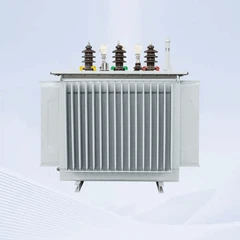




How to calculate the turns ratio of a power transformer?
Aug 12, 2025
Leave a message
As a seasoned supplier in the power transformer industry, I've witnessed firsthand the crucial role that power transformers play in electrical systems. One of the fundamental concepts in understanding power transformers is the turns ratio. In this blog, I'll delve into how to calculate the turns ratio of a power transformer, sharing insights and practical knowledge gained from years of experience.
Understanding the Basics of Power Transformers
Before we jump into calculating the turns ratio, let's briefly review what a power transformer is. A power transformer is an electrical device that transfers electrical energy between two or more circuits through electromagnetic induction. It consists of two or more coils of wire, known as windings, which are wound around a common core. The primary winding is connected to the input voltage source, while the secondary winding is connected to the load.
The main function of a power transformer is to change the voltage level of an alternating current (AC) electrical supply. It can either step up the voltage (increase the voltage level) or step down the voltage (decrease the voltage level) depending on the application. For example, in power transmission systems, transformers are used to step up the voltage to reduce power losses during long - distance transmission. At the consumer end, transformers are used to step down the voltage to a safe and usable level.
What is the Turns Ratio?
The turns ratio of a power transformer is defined as the ratio of the number of turns in the primary winding ($N_p$) to the number of turns in the secondary winding ($N_s$). Mathematically, it is expressed as:
[a=\frac{N_p}{N_s}]
The turns ratio is a key parameter that determines the voltage transformation ratio of the transformer. According to Faraday's law of electromagnetic induction, the induced voltage in a winding is proportional to the number of turns in that winding. So, the relationship between the primary voltage ($V_p$) and the secondary voltage ($V_s$) is given by:
[\frac{V_p}{V_s}=\frac{N_p}{N_s}=a]
This means that if the turns ratio $a > 1$, the transformer is a step - down transformer (since $V_p>V_s$), and if $a < 1$, the transformer is a step - up transformer (since $V_p < V_s$).
Calculating the Turns Ratio
There are several ways to calculate the turns ratio of a power transformer. The most straightforward method is when you know the primary and secondary voltages.
Method 1: Using Voltage Values
If you know the primary voltage $V_p$ and the secondary voltage $V_s$ of the transformer, you can calculate the turns ratio using the formula:
[a=\frac{V_p}{V_s}]
For example, if a transformer has a primary voltage of 1000 V and a secondary voltage of 100 V, then the turns ratio is:
[a=\frac{1000}{100}=10]
This indicates that the transformer is a step - down transformer, and there are 10 times as many turns in the primary winding as in the secondary winding.
Method 2: Measuring the Number of Turns
In some cases, you may need to physically measure the number of turns in the primary and secondary windings. This can be a more challenging method, especially for large - scale power transformers. However, for small - scale or experimental transformers, it can be done.
To measure the number of turns, you can carefully unwind the windings and count the number of turns. Once you have the values of $N_p$ and $N_s$, you can calculate the turns ratio using the formula $a = \frac{N_p}{N_s}$.
Method 3: Using Current Values
The turns ratio can also be calculated using the primary current ($I_p$) and the secondary current ($I_s$). According to the principle of conservation of energy in an ideal transformer (neglecting losses), the power in the primary winding is equal to the power in the secondary winding, i.e., $V_pI_p = V_sI_s$.
Since $\frac{V_p}{V_s}=\frac{N_p}{N_s}=a$, we can rewrite the power equation as:
[\frac{I_s}{I_p}=\frac{N_p}{N_s}=a]
So, if you measure the primary and secondary currents, you can calculate the turns ratio as the ratio of the secondary current to the primary current.


Practical Considerations in Turns Ratio Calculation
In real - world applications, there are some factors that need to be considered when calculating the turns ratio:
Transformer Losses
In an ideal transformer, there are no losses. However, in practical transformers, there are losses such as copper losses (due to the resistance of the windings) and iron losses (due to hysteresis and eddy currents in the core). These losses can cause the actual voltage and current ratios to deviate slightly from the theoretical values based on the turns ratio.
Load Conditions
The load connected to the secondary winding can also affect the voltage and current relationships in the transformer. When a load is connected, the secondary current flows, which in turn affects the magnetic field in the core and the primary current. Under heavy load conditions, the voltage drop across the internal impedance of the transformer can be significant, leading to a change in the secondary voltage.
Importance of the Turns Ratio in Transformer Selection
The turns ratio is a critical factor when selecting a power transformer for a specific application. For example, if you are designing a power supply for a low - voltage electronic device, you need a step - down transformer with an appropriate turns ratio to convert the high - voltage mains supply to a suitable low voltage.
At our company, we offer a wide range of power transformers with different turns ratios to meet various customer needs. For instance, our 33kv 12.5Mva Three Phase Power Transformer is designed for medium - voltage power distribution applications. It has a carefully calculated turns ratio to ensure efficient power transfer and voltage transformation.
Another product is our 121kv/50000 KVA On - load Voltage - changing Power Transformer (SZ11). This transformer is used in high - voltage power transmission systems and has a specific turns ratio to step up or step down the voltage as required. We also manufacture Manufactures 100kVA 3 Phase Oil Immersed Type Power Transformer, which is suitable for small - scale industrial and commercial applications.
Conclusion
Calculating the turns ratio of a power transformer is a fundamental aspect of understanding and working with transformers. Whether you are an electrical engineer designing a power system, a maintenance technician troubleshooting a transformer, or a customer looking to purchase a transformer, a good understanding of the turns ratio is essential.
If you are in the market for a power transformer and need assistance in selecting the right one with the appropriate turns ratio for your application, we are here to help. Our team of experts has extensive knowledge and experience in the power transformer industry. We can provide you with detailed technical information, product specifications, and support throughout the purchasing process. Feel free to contact us for further discussions and to start a procurement negotiation.
References
- Electric Machinery Fundamentals, Stephen J. Chapman
- Power System Analysis and Design, J. Duncan Glover, Mulukutla S. Sarma, Thomas J. Overbye
Send Inquiry