





What is the current density in the windings of a 75 kva dry type transformer?
Jul 24, 2025
Leave a message
What is the current density in the windings of a 75 kva dry type transformer?
As a leading supplier of 75 kVA dry type transformers, I often encounter inquiries about various technical aspects of our products. One of the frequently asked questions is about the current density in the windings of a 75 kVA dry type transformer. In this blog post, I will delve into the concept of current density, its significance in transformer design, and how it relates to our 75 kVA dry type transformers.
Understanding Current Density
Current density, denoted by the symbol 'J', is defined as the amount of electric current flowing per unit cross - sectional area of a conductor. Mathematically, it is expressed as (J=\frac{I}{A}), where (I) is the current flowing through the conductor and (A) is the cross - sectional area of the conductor. The unit of current density is amperes per square meter ((A/m^{2})) in the SI system, but in practical applications, it is often expressed in (A/mm^{2}).
In the context of a transformer, the windings are the conductors through which current flows. The current density in the windings plays a crucial role in determining the performance, efficiency, and thermal characteristics of the transformer.


Significance of Current Density in Transformer Design
Thermal Management
One of the primary reasons why current density is important in transformer design is its impact on heat generation. When current flows through a conductor, heat is generated due to the resistance of the conductor. According to Joule's law, the power dissipated as heat ((P)) is given by (P = I^{2}R), where (R) is the resistance of the conductor. Since (R=\rho\frac{l}{A}) ((\rho) is the resistivity, (l) is the length of the conductor, and (A) is the cross - sectional area), we can rewrite the power dissipation formula in terms of current density. Substituting (I = JA) into (P = I^{2}R), we get (P=(JA)^{2}\rho\frac{l}{A}=J^{2}\rho lA).
As the current density increases, the heat generated per unit volume of the conductor also increases. Excessive heat can lead to a rise in the temperature of the windings, which may cause insulation degradation, reduced lifespan of the transformer, and even failure. Therefore, an appropriate current density must be selected to ensure that the temperature rise of the windings is within acceptable limits.
Efficiency
Current density also affects the efficiency of the transformer. Higher current density means higher resistance losses ((I^{2}R) losses) in the windings, which reduces the overall efficiency of the transformer. By choosing an optimal current density, we can minimize these losses and improve the efficiency of the transformer.
Cost and Size
The cross - sectional area of the windings is directly related to the current density. A lower current density requires a larger cross - sectional area of the conductor, which increases the amount of copper or aluminum used in the windings. This, in turn, increases the cost and size of the transformer. On the other hand, a very high current density may lead to overheating and other performance issues. Therefore, a balance must be struck between cost, size, and performance when selecting the current density.
Current Density in a 75 kVA Dry Type Transformer
For a 75 kVA dry type transformer, the current density in the windings typically ranges from 2 to 4 (A/mm^{2}). The exact value depends on several factors, including the type of insulation, cooling method, and the design requirements of the transformer.
Insulation Type
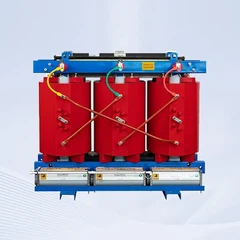
Dry type transformers use different types of insulation materials, such as epoxy resin, Nomex, etc. Each insulation material has a different temperature rating, which determines the maximum allowable temperature rise of the windings. For example, epoxy - resin - cast dry type transformers can generally tolerate higher temperatures compared to some other insulation materials. As a result, a slightly higher current density may be used in epoxy - resin - cast windings, provided that the thermal management system is designed to dissipate the heat effectively. You can learn more about 250kVA 10kV Epoxy Resin Casting Dry - type Transformer on our website.
Cooling Method
The cooling method also influences the current density. Dry type transformers can be cooled by natural air convection (AN) or forced air cooling (AF). In forced air - cooled transformers, the heat transfer rate is higher, which allows for a higher current density compared to naturally - cooled transformers.
Design Requirements
The design requirements of the transformer, such as efficiency, size, and cost, also play a role in determining the current density. If high efficiency is a priority, a lower current density may be selected to reduce the (I^{2}R) losses. If space is limited, a higher current density may be used, but this must be balanced with the thermal and performance requirements.
How We Ensure Optimal Current Density in Our 75 kVA Dry Type Transformers
As a supplier of 75 kVA dry type transformers, we take several steps to ensure that the current density in the windings is optimal.
Advanced Design Tools
We use advanced computer - aided design (CAD) and simulation tools to model the electrical and thermal behavior of the transformer. These tools allow us to analyze the current distribution in the windings and predict the temperature rise under different operating conditions. By adjusting the cross - sectional area of the conductors and other design parameters, we can optimize the current density to meet the performance and reliability requirements.
High - Quality Materials
We source high - quality copper or aluminum conductors for our windings. These materials have low resistivity, which helps to reduce the (I^{2}R) losses and allows for a more efficient use of the current density. In addition, we use high - performance insulation materials that can withstand the temperature rise associated with the selected current density.
Rigorous Testing
Before the transformers are shipped to our customers, they undergo rigorous testing to ensure that they meet the specified performance standards. We measure the temperature rise, efficiency, and other parameters under different load conditions to verify that the current density in the windings is within the acceptable range.
Other Related Products
In addition to our 75 kVA dry type transformers, we also offer a wide range of other dry type transformers, such as 50kVA Dry Type Transformer and 630 KVA - 0.4/0.4 KV Isolation Dry Type Transformer. These products are designed with the same attention to detail and quality, ensuring optimal current density and performance.
Conclusion
The current density in the windings of a 75 kVA dry type transformer is a critical parameter that affects the performance, efficiency, and thermal characteristics of the transformer. By understanding the concept of current density and its significance in transformer design, we can select an appropriate current density to ensure that the transformer operates reliably and efficiently. As a supplier of 75 kVA dry type transformers, we are committed to using advanced design tools, high - quality materials, and rigorous testing to optimize the current density in our products.
If you are interested in our 75 kVA dry type transformers or any other products, please feel free to contact us for more information and to discuss your specific requirements. We look forward to the opportunity to serve you and meet your transformer needs.
References
- Grover, F. W. (1946). Inductance Calculations: Working Formulas and Tables. Dover Publications.
- Westinghouse Electric Corporation. (1964). Electrical Transmission and Distribution Reference Book. Westinghouse Electric Corporation.
- IEEE Std C57.12.01 - 2010. IEEE Standard General Requirements for Dry - Type Distribution and Power Transformers.
Send Inquiry