







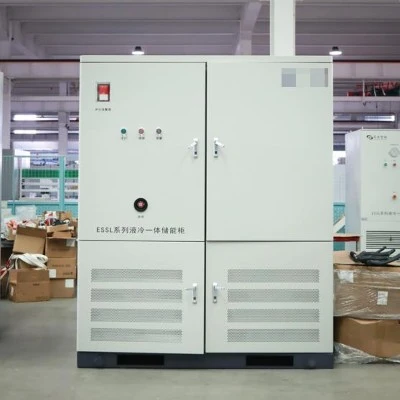


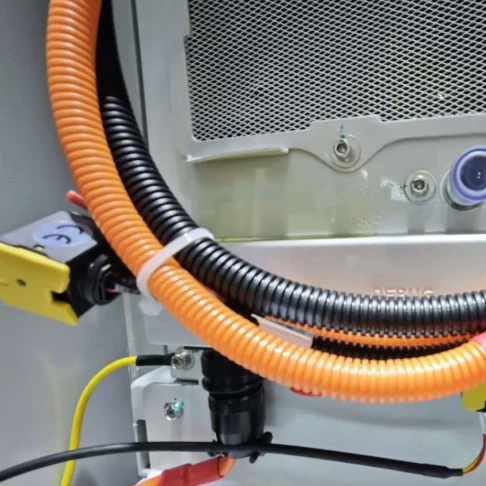
418kWh DC Liquid-Cooled Energy Storage Cabinet
Suggested PCS Power: 180KW/209KW
Cooling: Liquid-cooling
Protection: IP55
Cell Capacity: 280/314Ah
Certificates: IEC 62619, UL 1973, UL 9540A
Have questions? GNEE sales representatives are available for live chat now
Send E-mail: sales@gneeelectric.com
Tel: +8615824687445
Henan GNEE Electric Co., Ltd. is one of the most reliable manufacturers and suppliers of 418kwh dc liquid-cooled energy storage cabinet in China. If you're going to buy customized 418kwh dc liquid-cooled energy storage cabinet made in China, welcome to get quotation from our factory. Quality products and reasonable price are available.
What Is a 418kWh DC Liquid-Cooled Energy Storage Cabinet?

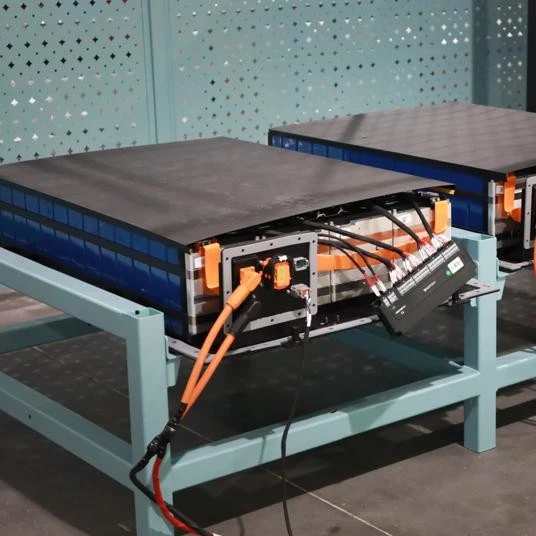
A 418kWh DC liquid-cooled energy storage cabinet is a freestanding, outdoor-rated battery enclosure that stores 418 kWh of usable LFP energy and delivers it on a high-voltage DC bus rather than as finished AC power. Inside the cabinet you will find eight liquid-cooled LFP battery packs wired in series, a high-voltage control box, a battery management system (BMS), a coolant loop with pump and plate heat exchanger, and an aerosol fire-suppression system.
The defining feature is the DC architecture. The cabinet terminates at a DC bus of roughly 1331.2 V nominal (1000–1500 V class). It does not contain a power conversion system (PCS). Instead, it connects to an external bidirectional PCS, a hybrid solar inverter, or a centralized MV-skid converter. Photovoltaic arrays, the battery, and the PCS share one DC bus, so solar energy reaches the battery without an intermediate DC→AC→DC round trip.
This matters for three reasons:
- Fewer conversion stages. DC-coupled architectures typically deliver 93–97 % system efficiency versus 90–94 % for AC-coupled systems, because PV-to-battery charging stays in the DC domain.
- Simpler line-up for a central PCS. One PCS can serve multiple parallel cabinets, which reduces per-kW converter cost on projects above 1 MWh.
- Better clipping recovery. When a PV array exceeds the inverter's AC rating, surplus DC power can be diverted straight into the battery instead of being curtailed.
If you are retrofitting storage onto an existing AC-coupled PV plant, an AC all-in-one cabinet is usually the lower-risk choice. If you are designing a new PV + storage plant, or a grid-only peak-shaving system with a central converter, the 418 kWh DC cabinet is the more efficient building block.
Where the 418 kWh number comes from
| Level | Configuration | Calculation | Result |
|---|---|---|---|
| Cell | LFP prismatic, 3.2 V / 314 Ah | 3.2 V × 314 Ah | 1,004.8 Wh |
| Pack | 1P52S | 52 × 1,004.8 Wh | 52.25 kWh (166.4 V nominal) |
| Cabinet | 1P416S (8 packs in series) | 8 × 52.25 kWh | 418 kWh (1331.2 V nominal) |
| DC window | 416 cells in series | 416 × 2.8 V → 416 × 3.6 V | 1164.8 – 1497.6 V |
| Power at 0.5P | 418 kWh × 0.5 /h | - | 209 kW (≈2 h discharge) |
Because the number is derived from cell count, "418 kWh" is a configuration, not a marketing figure - any cabinet quoting 418 kWh without a 1P416S / 1331.2 V description should be treated with caution.
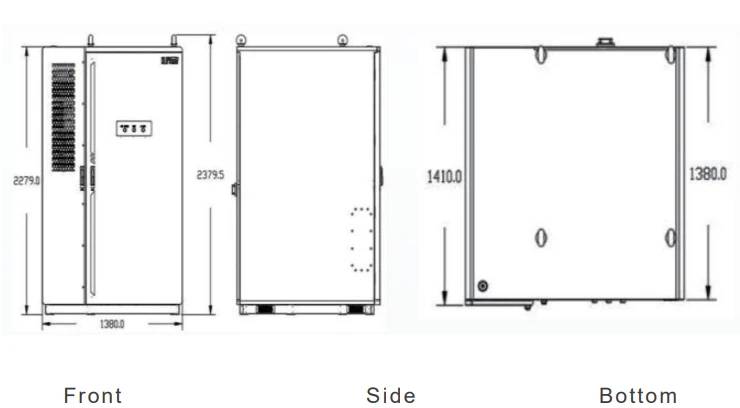
418kWh DC Liquid-Cooled BESS Technical Specifications
Values below are the standard 418 kWh DC configuration. Custom cell brands, 1P (0.5 h) discharge ratings and 690 V / 800 V AC interfaces via external PCS are available on request.
| Parameter | 418 kWh DC Liquid-Cooled Cabinet |
|---|---|
| Rated energy | 418 kWh @ 0.5P, 25 °C |
| Cell type | LFP (LiFePO₄) 3.2 V / 314 Ah prismatic |
| Pack configuration | 1P52S, 52.25 kWh, 166.4 V |
| System configuration | 1P416S |
| Nominal DC voltage | 1331.2 V DC |
| DC voltage range | 1164.8 – 1497.6 V DC |
| Max. charge / discharge rate | 0.5P (209 kW) |
| Max. depth of discharge | 100 % @ 25 ± 2 °C; 90 % recommended for cycle-life warranty |
| Cycle life | ≥ 8,000 cycles (0.5P, 25 °C, 90 % DoD, EOL 70 %) |
| DC-side round-trip efficiency | ≥ 95 % (0.5P, 25 °C, before PCS) |
| Cooling | Pack-level liquid cooling, water-glycol loop |
| Cell temperature difference | < 3 °C across all cells |
| Operating temperature | −25 °C to +55 °C (derating above 45 °C) |
| Storage temperature | −20 °C to +45 °C |
| Humidity | 0–95 % RH, non-condensing |
| Altitude | ≤ 2,000 m standard; up to 4,500 m with derating |
| Communication | CAN, RS485, Modbus TCP/IP, Ethernet |
| Fire suppression | In-pack aerosol + cabinet-level aerosol, smoke / temperature / combustible-gas detection, pressure-relief vent |
| Ingress protection | IP55 (cabinet) |
| Anti-corrosion | C4 standard, C5 optional |
| Dimensions (W × D × H) | 1,300 × 1,300 × 2,365 mm |
| Weight | ≈ 4,000 kg |
| Energy density | 247 kWh/m² of footprint |
| Parallel expansion | Up to 8 cabinets on a common DC bus (≈ 3.34 MWh) |
| Standards | IEC 62619, IEC 63056, IEC 62477-1, IEC 61000-6, UN38.3, UN3536, CE; UL 1973 / UL 9540A on request |
Need the full 418kWh DC cabinet datasheet (PDF) and a single-line diagram?
We send the datasheet, terminal layout, PCS matching list and shipping dimensions in one email. Tell us your grid voltage and target discharge hours.
How DC Battery System Works
In a DC battery system, solar panels generate drect curent electricity, which fows through an MPPT charge controller and is stored drecty n the DC batery system without AC conversion. When needed, the stored enery is sent to a bidirectional PCS (Power Conversion System) that converts it into AC power for use by the grid or on-site loads. This setup minimizes conversion losses and maximizes overall system efficiency.

DC-Coupled vs AC-Coupled: Where a 418kWh DC Battery Cabinet Wins
Choosing the coupling architecture is the single decision that shapes your project economics. Here is the honest comparison.
| Dimension | DC-coupled (this 418 kWh cabinet + external PCS) | AC-coupled (418 kWh all-in-one with built-in PCS) |
|---|---|---|
| PV → battery conversion stages | 1 (DC→DC) | 2 (DC→AC→DC) |
| Typical system efficiency | 93–97 % | 90–94 % |
| Best for | New-build PV + storage; grid-only peak shaving with central PCS; high-cycle duty | Retrofit on existing PV; phased build-out; microgrid / black start from one box |
| PV oversizing & clipping recovery | Excellent - surplus DC goes straight to battery | Limited by the PV inverter's AC rating |
| Expansion | Add cabinets on the DC bus; DC-bus voltage matching required | Add cabinets on the AC bus; simpler |
| Hardware count | Fewer converters, external PCS sized once | One PCS per cabinet |
| Single-vendor responsibility | Split between cabinet and PCS supplier | Single vendor |
| Footprint for 418 kWh | 1.69 m² | 2.0–2.4 m² |
Practical rule: if you already own a working PV plant with its own inverter, do not tear it out to save two efficiency points - take the AC-coupled route. If you are specifying PV + storage from scratch, or building a pure peak-shaving plant, the 418 kWh DC liquid-cooled cabinet is the more efficient foundation.
How to Size the PCS for a 418kWh DC Energy Storage Cabinet
The cabinet's kWh rating tells you how much energy you hold; the PCS kW rating tells you how fast you can use it. Same 418 kWh, completely different project.
| PCS rating | C-rate | Discharge duration | Usable energy per cycle (90 % DoD) | Fits which duty |
|---|---|---|---|---|
| 105 kW | 0.25P | 4 h | ≈ 376 kWh | Long-duration arbitrage, PV self-consumption, backup |
| 157 kW | 0.375P | ≈ 2.7 h | ≈ 376 kWh | Mixed peak shaving + backup |
| 209 kW | 0.5P | 2 h | ≈ 376 kWh | C&I peak shaving, demand-charge management, EV charger buffering |
| 418 kW | 1.0P | 1 h | ≈ 376 kWh | Frequency regulation, short high-power buffering |
Parallel Expansion: Scaling 418kWh DC Cabinets to MWh
Projects rarely stop at one cabinet. The 418 kWh DC cabinet is designed to be repeated:
- Up to 8 cabinets (≈ 3.34 MWh) can share a common DC bus and feed one centralised PCS
- For larger plants, cabinets are grouped into DC strings feeding PCS-boost containers at 690 V or medium voltage.
- On-grid, off-grid and hybrid operating modes are supported at system level by the PCS / EMS.

C&I Applications for a 418kWh DC Liquid-Cooled Energy Storage Cabinet
- Peak shaving and demand-charge management. Discharge 209 kW during your highest 15-minute demand window to cut the monthly demand charge. Typical peak-demand reduction on C&I sites: 20–40 %.
- Solar self-consumption. Store midday PV surplus and discharge after sunset. With DC coupling, PV-to-battery charging keeps the surplus instead of exporting it at a low feed-in tariff; self-consumption rates of 60–80 % are typical.
- EV fast-charging buffering. A 418 kWh cabinet buffers a cluster of DC fast chargers so the grid connection can be sized for average rather than peak load - often the difference between a grid upgrade and no grid upgrade.
- Backup power and power quality. With a suitable PCS, the cabinet covers critical loads during outages. Note that black start is a PCS function, not a cabinet function - specify it explicitly.
- Microgrid and off-grid. Paired with PV and a genset, the cabinet reduces diesel run-hours by 40–60 % on remote sites, mining camps and island grids.
- Utility and grid services. Frequency regulation, renewable smoothing and capacity firming where multiple cabinets are aggregated.

Tell us your destination port and grid voltage - we will confirm the certification package that actually clears your local AHJ.
Include country, grid voltage/frequency, discharge hours and whether PV is new-build or existing. We reply with the applicable standard list and a compliance gap check.

FAQ
What PCS power should I pair with a 418 kWh DC battery cabinet?
Match the PCS to your required discharge duration: 105 kW for 4 hours, 157 kW for ~2.7 hours, 209 kW (0.5P) for 2 hours. The cabinet's DC window is 1164.8–1497.6 V, so confirm the PCS delivers full power across that range, not just at 1000 V.
Can a 418 kWh DC cabinet output 690 V AC?
Not directly - 690 V AC is produced by the PCS, not the cabinet. Pair the cabinet with a 690 V PCS and you connect straight to industrial motors and MV step-up without a 400 V transformer stage.
How long will the 418 kWh liquid-cooled cabinet last?
≥ 8,000 cycles at 0.5P, 25 °C, 90 % DoD to 70 % end-of-life - about 3.0 GWh of lifetime throughput, or 15–20 years at one cycle per day. Keeping cell spread below 3 °C is what makes that number achievable; hot spots are what kill packs early.
Can I parallel multiple 418 kWh cabinets?
Yes - up to 8 cabinets (≈ 3.34 MWh) on a common DC bus with a centralised PCS, subject to the final electrical design. Ensure the design handles DC-bus voltage matching between cabinets at different states of charge, either with per-string DC/DC or PCS-managed string balancing.
Hot Tags: 418kwh dc liquid-cooled energy storage cabinet, China 418kwh dc liquid-cooled energy storage cabinet manufacturers, suppliers, factory
You Might Also Like


Send Inquiry