









50 kVA Oil-Immersed Transformer: Specifications and Applications
Jan 30, 2026
Leave a message
What Is a 50 kVA Oil-Immersed Transformer?
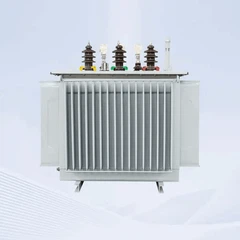
A 50 kVA oil-immersed transformer is a small distribution transformer that steps down medium voltage, typically 11 kV or 22 kV, to a standard low-voltage three-phase supply of 400 V or 415 V. The core and windings sit inside a sealed tank filled with insulating mineral oil, which provides both electrical insulation and cooling. In the most common configuration the cooling is classified as ONAN, meaning oil natural circulation and air natural cooling, and no pumps or fans are required. The unit is manufactured and tested in accordance with IEC 60076 for power transformers and GB 1094 for the Chinese national equivalent. Its compact size and moderate cost make it the usual choice for facilities whose connected load is too large for a 30 kVA unit but does not yet justify a 100 kVA transformer.
Typical Technical Specifications
The values below are typical parameters for a high-efficiency 50 kVA three-phase oil-immersed distribution transformer designed to IEC 60076. Actual values depend on the primary voltage, the vector group, and the efficiency class selected for the project.
| Parameter | Typical Value |
|---|---|
| Rated capacity | 50 kVA |
| Voltage ratio | 11,000 / 433 V; other ratios available |
| Vector group | Dyn11 |
| Impedance voltage | 4% |
| No-load loss | Approximately 170 W for an efficient core |
| Load loss at rated current | Approximately 870 W |
| Cooling type | ONAN |
| Temperature rise | 65 K top oil, 70 K average winding |
| Sound level | Not exceeding 55 dBA |
| Oil quantity | In the range of 250 to 300 litres |
Where a 50 kVA Transformer Is Most Useful
Because the 50 kVA rating is the upper end of the small distribution range, the unit serves a wide variety of growing loads. Common applications include medium industrial workshops running several machines, welding bays, and air compressors; agricultural processing facilities such as grain dryers, irrigation pump sets, and cold stores; small commercial premises including shops, offices, hotels, and supermarkets; and essential infrastructure such as water pumping stations and rural health clinics. In each case the transformer is normally installed on a plinth or pole, with the low-voltage side feeding a distribution board that protects the outgoing circuits.
Selecting and Sizing a 50 kVA Transformer
Sizing starts with the connected load. Sum the kVA of all equipment and apply an appropriate demand factor, because not all loads run at full output simultaneously. Add a growth margin of 15 to 25% so that the unit does not become overloaded when new equipment is added. Then confirm the incoming high-voltage line, the required low-voltage output, and the frequency, because 50 Hz and 60 Hz designs are not interchangeable. Where the site is coastal or industrial, specify a higher corrosion protection class for the tank and consider a higher protection rating for the accessories. It is also important to check the short-circuit impedance and the available fault level at the installation point so that the protection settings can be coordinated correctly.
Operation and Maintenance Essentials
An oil-immersed transformer is a sealed unit, but a few routine checks protect its service life. Inspect the oil level gauge and the silica gel breather periodically, because moist air entering the tank accelerates oil ageing. Check the thermometer reading under load and confirm that the top oil temperature stays within the guaranteed rise. For units fitted with a Buchholz relay, test the relay operation as part of the annual inspection. A periodic dissolved gas analysis of the oil, normally every three to five years for a small distribution transformer, provides an early warning of developing faults. Keeping the tank clean and the cooling fins free of dust and vegetation maintains the cooling performance of the ONAN design.
FAQ
Q: What is the typical price range of a 50 kVA oil-immersed transformer?
A: Prices vary with voltage ratio, core material, losses, and accessories, so a single figure is not meaningful. Buyers should compare quotations on the basis of total evaluated cost, including transport, installation, and the cost of losses over the expected 20 to 25 year life.
Q: Can a 50 kVA transformer supply a single-phase load?
A: The three-phase unit can feed single-phase loads connected between a phase and neutral, but the load must be reasonably balanced across the three phases. If the supply is single-phase only, a single-phase transformer is the correct choice.
Q: What does ONAN mean?
A: ONAN is the IEC 60076 cooling classification for oil natural and air natural. Heat from the windings rises through the oil to the tank walls and corrugated fins, where it is removed by natural air convection. No oil pump or cooling fan is fitted.
Q: What is the difference between the no-load loss and the load loss?
A: The no-load loss is the iron loss that occurs whenever the transformer is energised, regardless of load. The load loss is the copper loss that occurs in the windings at rated current and rises with the square of the current. Both are declared at the factory and verified by routine tests per IEC 60076-1.
Q: How often should the oil be tested?
A: For a sealed distribution transformer with a breather, a dielectric and moisture check of the oil every three to five years is reasonable, with dissolved gas analysis if a fault is suspected. Oil does not need regular replacement unless the test results fall below the limits of the applicable standard.
Q: Can the transformer be repaired if the winding fails?
A: Yes, failed windings of a distribution transformer can be rewound, and the tank, core, and accessories can be reused. In practice the decision between rewinding and replacement depends on the cost of the repair relative to a new unit and the required delivery time.
Send Inquiry