









7 routine tests for a dry-type transformer you should performduring commissioning
Apr 30, 2026
Leave a message
Every dry-type distribution transformer must undergo a defined set of routine tests before it is connected to the grid. These tests, mandated by IEC 60076-1 and IEC 60076-11, verify that the transformer's electrical, mechanical, and insulation characteristics meet design specifications.
Skipping or rushing through these seven dry-type transformer routine tests can lead to:
- Undetected internal winding faults that evolve into catastrophic failures
- Insulation breakdown under operating voltage
- Incorrect voltage ratios causing downstream equipment damage
- Premature aging due to excessive no-load losses
Learn more about GNEE dry-type transformers
GNEE performs every one of these seven routine tests on every dry-type transformer before it leaves our factory, and we strongly recommend that commissioning engineers repeat or verify key measurements on site.
The 7 Routine Tests for a Dry-Type Transformer During Commissioning
1. Dielectric Test - Separate-Source Voltage Withstand Test
The dielectric routine test applies a high-voltage AC waveform across each winding while all other windings, the core, frame, and enclosure are connected to earth.
- Test procedure: A sinusoidal voltage at rated frequency is applied for 60 seconds between the winding under test and all earthed components.
- Acceptance criteria: The test is successful if no breakdown, flashover, or partial discharge failure occurs during the full 60-second application.
- Test voltage formula: For dry-type transformers, the applied test voltage is typically 2 × rated voltage + 1,000 V, adjusted per the relevant IEC 60076-3 table for the equipment's highest voltage Um.
This test validates that the transformer's solid insulation system - whether cast resin or VPI impregnated - can withstand transient overvoltages that may occur during switching operations or lightning strikes.
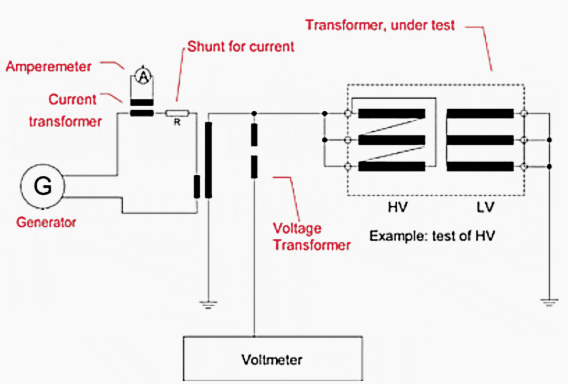
Dielectric tests - Separate-source voltage withstand test
2. Induced Voltage Test
The induced voltage routine test subjects the transformer to twice its rated voltage across the secondary winding terminals, with the primary winding left open.
- Test duration: 60 seconds at full test voltage at twice the rated frequency.
- Ramp sequence: The voltage starts below one-third of the full test value, is rapidly increased, and at the end is rapidly reduced to below one-third before disconnection.
- Frequency requirement: Twice the rated frequency is applied to avoid magnetic core saturation while doubling the voltage.
Any failure during this test - such as partial discharge, audible corona, or insulation puncture - indicates a serious winding insulation defect that must be corrected before the transformer can be safely energized.
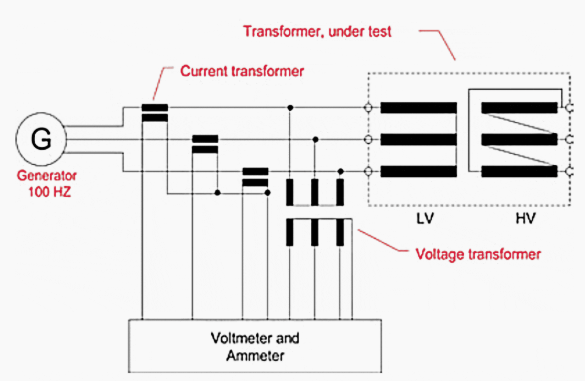
Induced Voltage Test
3.Voltage Ratio Measurement and Check of Polarity / Connections
The voltage ratio measurement routine test ensures that the transformer will deliver the correct secondary voltage at every tap position.
- Method: Potentiometric measurement, phase by phase, between the corresponding terminals of each winding pair.
- Tap changer verification: The measurement must be repeated at all tap changer positions to confirm that each step produces the correct voltage ratio.
- Polarity and vector group check: The connection group designation (e.g., Dyn11, Yyn0) must match the nameplate data.
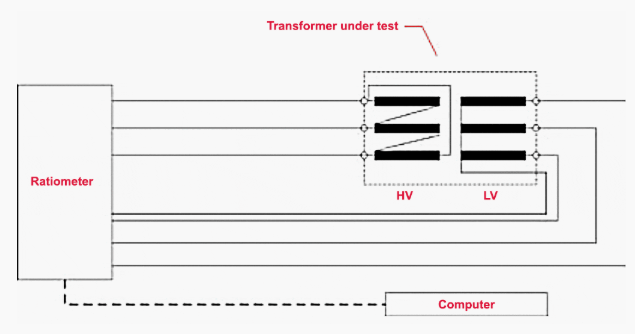
Voltage Ratio Measurement and Check of Polarity / Connections
The acceptable deviation from the rated ratio is typically:
| Tap Position | Maximum Ratio Deviation |
|---|---|
| Rated (principal) tap | ±0.5% |
| All other tap positions | ±1.0% |
Deviations exceeding these limits suggest shorted turns, incorrect winding connections, or tap changer misalignment. At GNEE, we test every transformer at every tap setting and record the results in the final test report that accompanies each shipment.
4. No-Load Current and No-Load Loss Measurement
This routine test for dry-type transformer efficiency measures the core's magnetic performance by energizing the secondary winding at rated voltage and frequency while the primary remains open.
- Measurement parameters: No-load current (excitation current), no-load losses (iron losses), and the mean and RMS value of the applied voltage.
- Frequency tolerance: The test frequency must not deviate from rated by more than ±1%.
- Sine-wave correction: If the mean and RMS voltage readings differ, the measured no-load loss must be corrected to sine-wave conditions per IEC 60076-1 Annex A.
- Averaging: No-load current is the arithmetic mean of three effective-value ammeter readings.

No-Load Current and No-Load Loss Measurement
High no-load current or losses compared to factory baselines may indicate:
- Degraded core lamination insulation (possible during transport damage)
- Moisture ingress in the insulation system
- Manufacturing defects in the core assembly
GNEE's dry-type transformers are designed for low no-load losses, meeting or exceeding efficiency classes defined by regional energy regulations. Every unit's no-load measurement is documented in the test certificate.
5. Winding Resistance Measurement
Winding resistance measurement shall be performed when the windings are at ambient temperature without supply for a time long enough to achieve this condition. The measurements shall be carried out in direct current between terminals according to the sequence U-V; V-W; WU.
Ambient temperature shall also be measured. It shall result as the average value of three measurements performed by apposite thermal sensors.
5.1 HV Winding Resistance Measurement
HV winding resistance measurement shall be performed by measuring simultaneously voltage and current. The voltmeter and ammeter must be connected as follows:
- Voltmeter terminals must be connected beyond current cables;
- The current shall not exceed 10% of winding rated current;
- The measurement shall be carried out after voltage and current are stable.
- Unless otherwise agreed, the HV winding shall be connected on principal tapping.
5.2 LV Winding Resistance Measurement
LV winding resistance measurement shall be performed by measuring simultaneously voltage and current.
The voltmeter and ammeter shall be connected as follows:
- Voltmeter terminals shall be connected beyond current cables;
- The current shall not exceed 5% of winding rated current;
- The measurement shall be carried out after voltage and current are stable.
6. Measurement of Short-Circuit Impedance and Load Loss
This routine test determines the short-circuit impedance of the transformer, a critical parameter for coordinating protection devices and calculating prospective fault currents.
- Procedure: One winding is short-circuited while voltage is applied to the other winding until rated current flows.
- Measurements: The input voltage (proportional to impedance), input power (load loss), and current are recorded.
- Temperature correction: Load losses are corrected to a reference temperature of 75°C for comparison with guaranteed values.
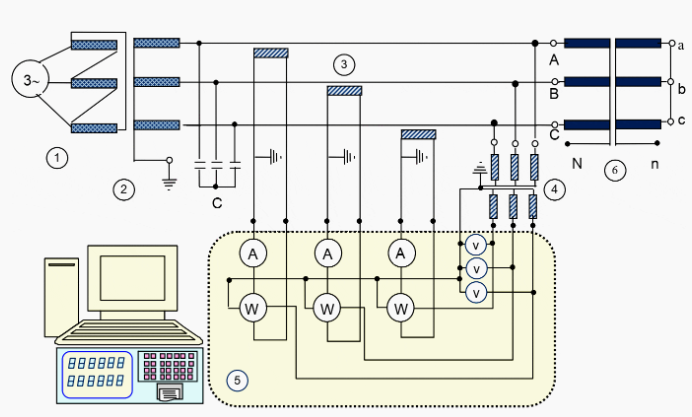
Short-circuit losses measurement connection diagram
The measured short-circuit impedance is normally expressed as a percentage of the rated impedance:
| Transformer Power Rating | Typical Impedance Range (% Z) |
|---|---|
| ≤ 630 kVA | 4.0% – 4.5% |
| 800 – 1,600 kVA | 5.0% – 6.0% |
| ≥ 2,000 kVA | 6.0% – 8.0% |
The impedance tolerance per IEC 60076-1 is ±10% of the declared value. A deviation beyond this band can indicate winding deformation, core displacement, or incorrect winding geometry - all of which must be investigated before energization.
7. Partial Discharge Measurement
All PD measuring methods are based on the detection of PD current impulses i(t) circulating in the parallel-connected capacitors Ck (coupling capacitor) and Ct (test object capacitance) via measuring impedance Zm.
The basic equivalent circuit for PD measurements is presented in the figure.
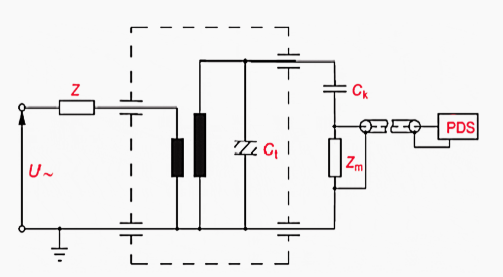
Test circuit for measurement without capacitive tap
Where:
- PDS = PD system
- Ck = coupling capacitor
- Ct = test object capacitance
- Z = voltage source connection
- Zm = measuring impedance
The measuring impedance Zm can either be connected in series with coupling capacitor Ck or with the test object capacitance Ct. PD current impulses are generated by charge transfers between parallel-connected capacitor Ck (coupling capacitor) and Ct (test object capacitance).
Present IEC and IEEE Standards have both established rules for measuring and evaluating electric signals caused by partial discharges together with specifications on permissible magnitude. The IEC approach to the processing of the recorded electric signal is different from the IEEE approach.
IEC transforms the signal to an apparent electric charge generally measured in picocoulombs (pC), while IEEE transforms the signal to a Radio Interference Voltage (RIV), generally measured in micro volts (µV). The use of the RIV-method for PD-signal detection will be abandoned, although the IEEE standard has not yet been officially approved.
The detection of apparent charge in pC is the preferred method now in use in IEEE Std. C57.113.
For the detection of apparent charge the integration of the PD-current impulses i(t) is required.
Integration of the PD current impulses can be performed either in the time domain (digital oscilloscope) or in the frequency domain (band-pass filter). Most PD systems available on the market perform a "quasi integration" of the PD current impulses in the frequency domain using a "wide-band" or "narrow-band" filter.
Circulating PD current impulses – generated by an external PD source (in the test circuit) or by an internal PD source (in the insulating system of the transformer) – can only be measured at the transformer bushings.
Bushing capacitance C1, represents the coupling capacitor Ck, which is connected in parallel with capacitance Ct (test object = total capacitance of the transformer insulating system).
Conclusion - Schedule Your Dry-Type Transformer Commissioning Tests with Confidence
The seven routine tests for a dry-type transformer during commissioning are not optional formalities - they are essential quality gates that verify equipment integrity, ensure personnel safety, and protect your project's reputation. From dielectric withstand and induced voltage tests to winding resistance and short-circuit impedance measurements, each test reveals specific potential failure modes before they become operational disasters.
Are you planning a project that requires IEC-compliant dry-type transformers with full factory test documentation?
Contact GNEE today for a custom quotation and factory test specification package.
Let GNEE be your direct manufacturer partner for tested, certified, and reliable dry-type power transformers.
Send Inquiry