









Amorphous Core Vs Silicon Steel
Aug 15, 2025
Leave a message
Amorphous cores offer significantly lower core losses (hysteresis and eddy current losses) than silicon steel cores, resulting in higher energy efficiency and reduced operating costs, especially in transformers. However, silicon steel cores have a higher saturation flux density and greater mechanical robustness. While silicon steel is a more established and versatile material for high power applications, amorphous cores are ideal for reducing no-load losses in applications with extended idle periods or constant energization, like renewable energy grids.
Amorphous Cores
Structure:
Composed of metallic alloys with a non-crystalline, disordered atomic structure, formed by rapidly cooling molten metal into ultra-thin ribbons.
Advantages:
- Lower Core Losses: Significantly reduced hysteresis and eddy current losses due to the absence of grain boundaries and ultra-thin laminations.
- Higher Energy Efficiency: Leads to lower energy bills and reduced carbon footprints, especially in applications with constant or extended idle periods.
- Ideal for Specific Applications: Well-suited for renewable energy grids, smart power distribution networks, and constant energization scenarios where no-load losses are critical.
Disadvantages:
- Brittle & Fragile: More susceptible to stress and potential fractures, requiring protective measures during installation and transport.
- Lower Saturation Flux Density: Not as suitable for high-power, high-load applications compared to silicon steel.
- Limited Width: The narrow width of amorphous ribbons can restrict design flexibility for larger transformers.
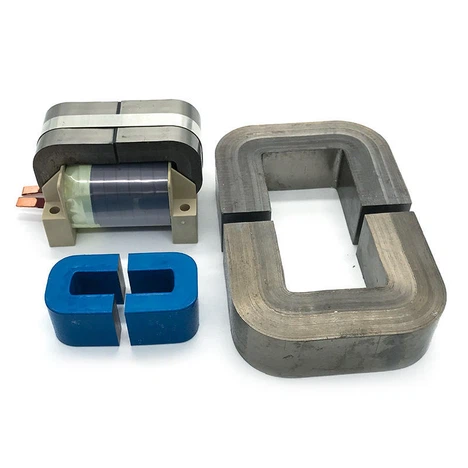
Silicon Steel Cores
Structure:
Made from grain-oriented silicon steel with an ordered atomic structure that facilitates magnetic flux movement.
Advantages:
- Higher Saturation Flux Density: More suitable for high-power and high-load applications.
- Greater Mechanical Robustness: Stronger and less brittle than amorphous materials.
- Established and Versatile: A well-established, more flexible material for various transformer designs.
Disadvantages:
- Higher Core Losses: Crystalline structure creates grain boundaries, increasing hysteresis and eddy current losses.
- Thicker Laminations: Requires thicker laminations to control eddy currents, which adds to the core loss.
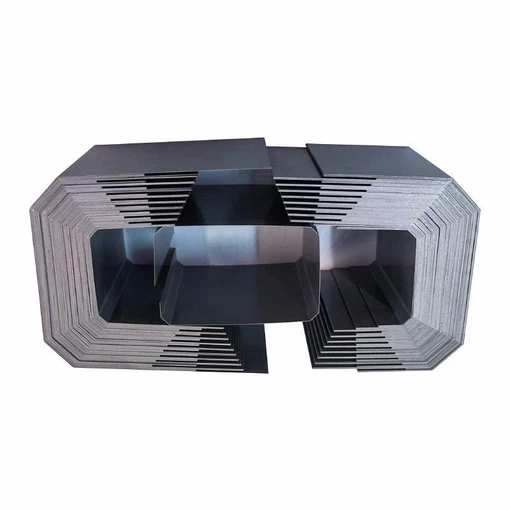
Key Differences
- Losses:Amorphous cores have lower hysteresis and eddy current losses than silicon steel, making them more efficient.
- Structure:Amorphous materials are non-crystalline, while silicon steel is crystalline with a structured atomic alignment.
- Application:Silicon steel excels in high-power applications, while amorphous cores are preferred for high-efficiency applications with constant or long periods of low-load operation.
Send Inquiry