


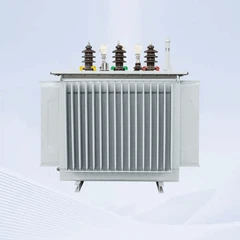




How to measure the short - circuit impedance of a distribution transformer?
Jun 17, 2025
Leave a message
Measuring the short-circuit impedance of a distribution transformer is a crucial aspect in the field of power distribution. As a supplier of distribution transformers, understanding and accurately measuring this parameter is not only essential for ensuring the quality and performance of our products but also for meeting the diverse needs of our customers. In this blog, we will delve into the details of how to measure the short-circuit impedance of a distribution transformer.
Understanding Short-Circuit Impedance
Before we jump into the measurement process, it's important to understand what short-circuit impedance is. The short-circuit impedance of a distribution transformer is the impedance presented by the transformer when its secondary winding is short-circuited, and a rated frequency voltage is applied to the primary winding to circulate the rated current. It is expressed as a percentage of the rated voltage and plays a significant role in determining the transformer's performance under short-circuit conditions. A proper short-circuit impedance value ensures that the transformer can withstand short-circuit currents without excessive damage and also affects the voltage regulation of the transformer.
Importance of Measuring Short-Circuit Impedance
Measuring the short-circuit impedance is vital for several reasons. Firstly, it helps in verifying the design and manufacturing quality of the transformer. By comparing the measured value with the designed value, we can identify any potential manufacturing defects or deviations. Secondly, it is crucial for system protection coordination. The short-circuit impedance affects the magnitude of the short-circuit current in the power system, and accurate measurement is necessary for proper sizing of protective devices such as circuit breakers and fuses. Additionally, it provides valuable information for the operation and maintenance of the transformer, allowing us to assess its health and performance over time.
Measurement Methods
There are primarily two methods for measuring the short-circuit impedance of a distribution transformer: the direct measurement method and the calculation method based on no-load and short-circuit tests.
Direct Measurement Method
The direct measurement method involves applying a reduced voltage to the primary winding of the transformer while the secondary winding is short-circuited. The applied voltage is adjusted until the rated current flows through the windings. The short-circuit impedance can then be calculated using the measured voltage, current, and power values.
Here are the steps for the direct measurement method:
- Preparation: Ensure that the transformer is in a safe and de-energized state. Connect the measuring equipment, including a voltmeter, ammeter, and wattmeter, to the primary winding. Short-circuit the secondary winding using appropriate short-circuiting bars.
- Applying Voltage: Gradually apply a reduced voltage to the primary winding using a variable voltage source. Monitor the current flowing through the windings using the ammeter. Adjust the voltage until the rated current is reached.
- Measurement: Once the rated current is flowing, record the values of the voltage, current, and power using the voltmeter, ammeter, and wattmeter, respectively.
- Calculation: Calculate the short-circuit impedance using the following formulas:
- The short-circuit impedance in ohms ($Z_{sc}$) can be calculated using Ohm's law: $Z_{sc}=\frac{V_{sc}}{I_{sc}}$, where $V_{sc}$ is the short-circuit voltage and $I_{sc}$ is the short-circuit current.
- The short-circuit impedance in percentage ($Z_{sc}%$) can be calculated as: $Z_{sc}%=\frac{V_{sc}}{V_{rated}}\times100$, where $V_{rated}$ is the rated voltage of the primary winding.
Calculation Method Based on No-Load and Short-Circuit Tests
This method involves performing both no-load and short-circuit tests on the transformer. The no-load test is used to determine the core losses and the magnetizing impedance of the transformer, while the short-circuit test is used to determine the copper losses and the short-circuit impedance.
Here are the steps for the calculation method:
- No-Load Test: Apply the rated voltage to the primary winding while the secondary winding is open-circuited. Measure the no-load current, voltage, and power. The no-load losses ($P_{0}$) and the magnetizing impedance ($Z_{m}$) can be calculated from the measured values.
- Short-Circuit Test: Apply a reduced voltage to the primary winding while the secondary winding is short-circuited. Adjust the voltage until the rated current flows through the windings. Measure the short-circuit voltage, current, and power. The copper losses ($P_{sc}$) and the short-circuit impedance ($Z_{sc}$) can be calculated from the measured values.
- Calculation of Short-Circuit Impedance: The short-circuit impedance can be calculated using the following formulas:
- The equivalent resistance of the windings ($R_{eq}$) can be calculated as: $R_{eq}=\frac{P_{sc}}{I_{sc}^{2}}$, where $P_{sc}$ is the short-circuit power and $I_{sc}$ is the short-circuit current.
- The equivalent reactance of the windings ($X_{eq}$) can be calculated as: $X_{eq}=\sqrt{Z_{sc}^{2}-R_{eq}^{2}}$, where $Z_{sc}$ is the short-circuit impedance calculated from the short-circuit test.
Equipment Required
To measure the short-circuit impedance of a distribution transformer, the following equipment is required:
- Variable Voltage Source: This is used to apply a reduced voltage to the primary winding during the short-circuit test.
- Voltmeter: Used to measure the voltage across the primary winding.
- Ammeter: Used to measure the current flowing through the primary winding.
- Wattmeter: Used to measure the power consumed during the short-circuit test.
- Short-Circuiting Bars: Used to short-circuit the secondary winding.
Precautions
When measuring the short-circuit impedance of a distribution transformer, the following precautions should be taken:
- Safety First: Ensure that all safety procedures are followed during the measurement process. The transformer should be de-energized before connecting or disconnecting any measuring equipment.
- Accurate Measurement: Use high-quality measuring equipment and ensure that it is properly calibrated. Take multiple measurements to ensure accuracy and reliability.
- Temperature Correction: The short-circuit impedance is affected by the temperature of the windings. Therefore, it is necessary to correct the measured values to the reference temperature (usually 75°C for copper windings).
Our Products and Their Short-Circuit Impedance
As a leading supplier of distribution transformers, we offer a wide range of products with different ratings and specifications. For example, our High Quality 200kVA 11/0.4kv Small Distribution Transformer and 500kVA HV Power Distribution Transformer are designed and manufactured to meet the highest quality standards. We ensure that the short-circuit impedance of our transformers is accurately measured and within the specified range to guarantee their performance and reliability.
In addition to distribution transformers, we also provide related products such as the 380V Low-Voltage Power Electrical Cabinet, which is an essential component in the power distribution system.


Conclusion
Measuring the short-circuit impedance of a distribution transformer is a critical process that requires careful attention and accurate measurement techniques. By understanding the importance of short-circuit impedance and using the appropriate measurement methods, we can ensure the quality and performance of our transformers. As a trusted supplier of distribution transformers, we are committed to providing our customers with high-quality products and reliable services. If you are interested in our products or have any questions about measuring short-circuit impedance, please feel free to contact us for further discussion and procurement.
References
- "Power System Analysis" by John J. Grainger and William D. Stevenson Jr.
- "Transformer Engineering: Design, Technology, and Diagnostics" by Tapan K. Bhattacharya.
Send Inquiry