





What is the relationship between the turns ratio and voltage in a large power transformer?
Sep 11, 2025
Leave a message
In the realm of electrical engineering, large power transformers play a pivotal role in the efficient transmission and distribution of electrical energy. As a leading supplier of large power transformers, I have witnessed firsthand the significance of understanding the relationship between the turns ratio and voltage in these complex devices. This blog post aims to delve into this crucial relationship, exploring its theoretical underpinnings, practical implications, and real-world applications.
Theoretical Foundation
At the heart of every transformer lies the principle of electromagnetic induction, discovered by Michael Faraday in the 19th century. A transformer consists of two or more coils of wire, known as windings, wound around a common magnetic core. When an alternating current (AC) flows through the primary winding, it creates a changing magnetic field in the core. This changing magnetic field then induces an electromotive force (EMF) in the secondary winding, according to Faraday's law of electromagnetic induction.
The turns ratio of a transformer is defined as the ratio of the number of turns in the secondary winding ($N_s$) to the number of turns in the primary winding ($N_p$). Mathematically, it is expressed as:
[
\text{Turns Ratio} (a)=\frac{N_s}{N_p}
]
The relationship between the voltage in the primary winding ($V_p$) and the voltage in the secondary winding ($V_s$) is directly proportional to the turns ratio. This relationship is given by the following equation:
[
\frac{V_s}{V_p}=\frac{N_s}{N_p}=a
]
This equation shows that the voltage ratio between the primary and secondary windings is equal to the turns ratio. If the turns ratio is greater than 1 ($a > 1$), the transformer is a step-up transformer, which increases the voltage from the primary to the secondary winding. Conversely, if the turns ratio is less than 1 ($a < 1$), the transformer is a step-down transformer, which decreases the voltage.
Practical Implications
The relationship between the turns ratio and voltage has several practical implications in the design and operation of large power transformers.
Voltage Transformation
The primary function of a power transformer is to transform voltage levels. In power transmission systems, step-up transformers are used to increase the voltage from the generating stations to high levels (e.g., 110 kV, 220 kV, or even higher) for efficient long-distance transmission. This reduces the current flowing through the transmission lines, minimizing power losses due to resistance. At the receiving end, step-down transformers are used to decrease the voltage to levels suitable for distribution and end-use applications (e.g., 11 kV for industrial use and 230 V/400 V for domestic use).
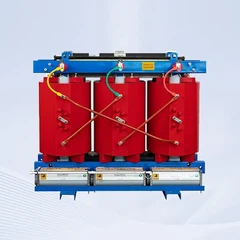
For example, consider a GNEE EC 3000KVA Power Transformer Supplier. This transformer can be designed with an appropriate turns ratio to step up or step down the voltage according to the specific requirements of the power system.
Power Transfer
The turns ratio also affects the power transfer in a transformer. According to the principle of conservation of energy, the power input to the primary winding ($P_p = V_pI_p$) is equal to the power output from the secondary winding ($P_s = V_sI_s$), neglecting losses. Using the voltage ratio equation, we can derive the relationship between the currents in the primary and secondary windings:
[
\frac{I_s}{I_p}=\frac{N_p}{N_s}=\frac{1}{a}
]
This shows that the current ratio is inversely proportional to the turns ratio. In a step-up transformer, the voltage increases, but the current decreases, while in a step-down transformer, the voltage decreases, and the current increases.
Impedance Matching
In some applications, such as in audio systems and telecommunications, transformers are used for impedance matching. The impedance of a circuit is a measure of its opposition to the flow of alternating current. By choosing an appropriate turns ratio, a transformer can match the impedance of a source to the impedance of a load, maximizing the power transfer between the two.


Real-World Applications
The relationship between the turns ratio and voltage is crucial in various real-world applications of large power transformers.
Power Generation and Transmission
In power generation plants, large step-up transformers are used to connect the generators to the high-voltage transmission grid. For instance, a power plant generating electricity at 11 kV may use a step-up transformer with a turns ratio of 1:20 to increase the voltage to 220 kV for transmission. This reduces the power losses in the transmission lines and allows for efficient long-distance power transfer.
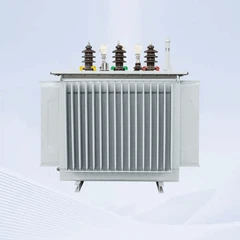
On the other hand, at the substations near the load centers, step-down transformers are used to reduce the voltage from the transmission level to the distribution level. A Step Down Oil Immersed Power Transformer 11kv 1000kVA Hot Selling is a typical example of a transformer used in distribution networks to supply power to industrial and commercial consumers.
Industrial Applications
In industries, large power transformers are used to supply power to various electrical equipment. Different types of equipment may require different voltage levels, and transformers are used to step down the voltage from the distribution network to the appropriate levels. For example, an industrial plant may use a transformer to step down the voltage from 11 kV to 400 V for operating motors, lighting systems, and other electrical devices.
Renewable Energy Systems
With the increasing adoption of renewable energy sources such as solar and wind, large power transformers are also playing a crucial role in integrating these sources into the power grid. Solar power plants and wind farms often generate electricity at relatively low voltages, and step-up transformers are used to increase the voltage to the grid level for transmission.
Conclusion
In conclusion, the relationship between the turns ratio and voltage is fundamental to the operation of large power transformers. Understanding this relationship is essential for the design, selection, and operation of transformers in power systems. By carefully choosing the turns ratio, engineers can achieve efficient voltage transformation, power transfer, and impedance matching.
As a supplier of large power transformers, we offer a wide range of Electric Transformers with different turns ratios to meet the diverse needs of our customers. Whether you need a step-up transformer for power transmission or a step-down transformer for distribution, we have the expertise and experience to provide you with the right solution.
If you are interested in purchasing large power transformers or have any questions about the relationship between the turns ratio and voltage, please feel free to contact us for a detailed discussion. Our team of experts is ready to assist you in finding the most suitable transformer for your specific requirements.
References
- Grover, F. W. (1946). Inductance Calculations: Working Formulas and Tables. Dover Publications.
- Chapman, S. J. (2012). Electric Machinery Fundamentals (5th ed.). McGraw-Hill Education.
- Alexander, C. K., & Sadiku, M. N. O. (2016). Fundamentals of Electric Circuits (5th ed.). McGraw-Hill Education.
Send Inquiry