


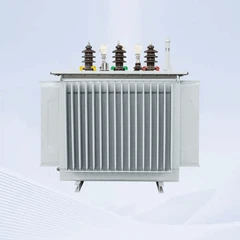





What Is the Purpose of an Oil-Immersed Transformer?
Nov 12, 2025
Leave a message
The Core Function: Voltage Conversion at Network Scale
The purpose of an oil-immersed transformer is to change alternating voltage and current from one level to another at high efficiency, so that power can be generated at the most economical voltage, transmitted at a voltage that keeps losses and conductor size reasonable, and distributed at a voltage that equipment and people can use safely. Almost all of that duty is done by transformers whose magnetic core and windings are fully immersed in insulating oil. The oil is not an accessory; it is the medium that makes the higher voltage classes practical.
Because the oil surrounds every turn, it insulates conductor to conductor, conductor to core and winding to tank, and it also carries the heat generated by core and winding losses out to the radiators and tank walls. Remove the oil and the same electrical design would either need much greater clearances in air or run at a small fraction of its rating.
What the Insulating Oil Actually Does
The oil performs three functions. As a dielectric it has a breakdown strength many times that of air, so insulation distances can be short and the transformer compact. As a coolant it circulates by convection through ducts in the winding and out to the radiator bank, transferring heat to the ambient air. As an impregnant it fills the spaces in paper and pressboard insulation, suppressing the partial discharge that would otherwise occur in voids.
The oil condition is therefore a direct measure of the transformer condition, and the test programme follows that logic.
| Property | What it indicates | Reference method |
|---|---|---|
| Dielectric breakdown voltage | Moisture and particulate contamination | ASTM D877 / ASTM D1816 |
| Flash and fire point | Oil identity, contamination by a lighter fraction | ASTM D92 |
| Dissolved gas content | Overheating, arcing and discharge inside the unit | IEC 60599 |
| Acidity and interfacial tension | Oxidation of the oil and ageing of the paper | IEC 60296 requirements |
A rising moisture content is the classic pattern: it lowers the dielectric strength and at the same time accelerates the ageing of the kraft paper on the winding, so a falling breakdown voltage is an early warning rather than a routine variation.
Cooling Classes and How They Set the Rating
The nameplate cooling designation describes which cooling stages are in service. A unit marked ONAN cools by natural oil circulation and natural air circulation up to its base rating. Adding fans gives ONAF and a higher rating; adding oil pumps gives OFAF, and directing the oil flow through the winding gives ODAF with a further step in rating. Each stage is a real load capability, not an option list, and the temperature rise limits that apply at each stage are set under IEC 60076-2. Loading beyond the nameplate is governed by the thermal guidance in IEC 60076-7.
Insulation levels and the dielectric tests that verify them are specified under IEC 60076-3, and the bushings that bring the leads through the tank follow IEC 60137. Sound power levels, increasingly a constraint in urban substations, are determined under IEC 60076-10.
Where Oil-Immersed Units Are Specified
The type dominates from distribution voltage up to the highest transmission levels, and it is the default choice for outdoor installations where a transformer compound or oil room can be provided. Its advantages are a high thermal capacity, a short-term overload capability that follows the oil time constant, and a mature body of test and maintenance practice. The trade-offs are the fire load represented by several tonnes of combustible liquid, the need for oil containment and, in some locations, a fire-rated separation from other equipment.
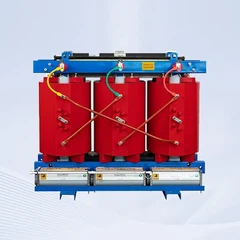
Where those constraints cannot be met, dry-type transformers take over, at the cost of a lower overload capability. The choice is normally decided by location and by load profile, not by voltage alone: a factory unit in an outdoor compound is an oil-immersed machine, while the same rating inside a public building usually becomes a dry-type.
Rating, Losses and Load Envelope
Two figures decide the running cost of an oil-immersed transformer: no-load loss, which is present whenever the unit is energised, and load loss, which rises with the square of the current. Because load loss heats the winding, it directly limits how much load can be carried at a given ambient, and the continuous rating is always quoted with a reference ambient and a defined cooling stage. For a purchase decision, request the guaranteed no-load and load losses, the impedance, the temperature rise limit and the applicable cooling class, and check the losses against the total cost of ownership over the intended life rather than on first cost alone.
Frequently Asked Questions
Q: What is the main purpose of the oil in an oil-immersed transformer?
A: It acts as both dielectric and coolant. It insulates the live parts from each other and from earth, and it carries heat from the core and windings to the radiators where it is dissipated to the air.
Q: How often should transformer oil be tested?
A: Dielectric breakdown and moisture are normally checked at fixed intervals, with dissolved gas analysis added for larger or critically loaded units. The results are read as trends, and a sudden change is investigated regardless of whether the absolute value is still acceptable.
Q: What does ONAN mean on a transformer nameplate?
A: Oil natural, air natural: the oil circulates by convection and the radiators cool by natural air movement. That is the base rating. Adding fans or pumps creates further cooling stages with higher ratings.
Q: Why is dissolved gas analysis used?
A: Different faults produce different gases. Overheated cellulose, overheated oil, partial discharge and arcing each leave a characteristic pattern, and interpreting it under IEC 60599 identifies the fault type before it develops into a failure.
Q: Can an oil-immersed transformer be installed indoors?
A: It can, but the installation then needs oil containment, fire-rated separation and ventilation, which is why dry-type units are usually preferred inside buildings and in public-access locations.
Q: Does the oil need to be replaced during the life of the transformer?
A: Not normally. With the tank sealed and the oil in good condition, replacement is not a scheduled item. Oil treatment or replacement is done when the test results show moisture, acidity or gas levels that cannot be corrected by processing.
Send Inquiry