





Working Principle of 1000kVA Dry Type Transformer
Apr 16, 2026
Leave a message
To appreciate the reliability of the GNEE 1000kVA Dry Type Transformer, it is essential to understand the sophisticated engineering behind its operation. Unlike traditional oil-immersed units, a Three-Phase Dry-type Transformer relies on air and solid insulation materials to manage voltage conversion.
As a specialist cast resin dry type transformer manufacturer, GNEE utilizes the principles of electromagnetic induction combined with advanced material science to ensure that power is stepped down safely and efficiently for indoor applications.
Faraday's Law and the Three-Phase Dry-type Transformer Core
At its most fundamental level, the 1000kVA Dry Type Transformer operates based on Faraday's Law of Electromagnetic Induction. When an alternating current (AC) flows through the primary winding, it creates a varying magnetic flux in the laminated silicon steel core. This flux then travels through the dry core transformer and induces a voltage in the secondary winding.
The "Three-Phase" aspect refers to the three sets of primary and secondary windings arranged around the core. In a Three-Phase Cast Resin Transformer, these phases are displaced by 120 degrees, providing a balanced and continuous power flow that is essential for the heavy-duty motors and sensitive servers found in high-rise buildings and data centers. By precision-engineering the turn ratio of these windings, GNEE ensures an accurate voltage output with minimal energy deviation.

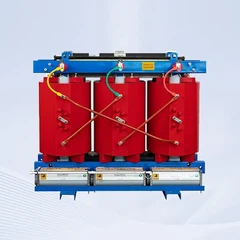
The core, H.V. windings, and L.V. windings of a cast resin power transformer.
How Cast Resin Technology Revolutionizes Insulation
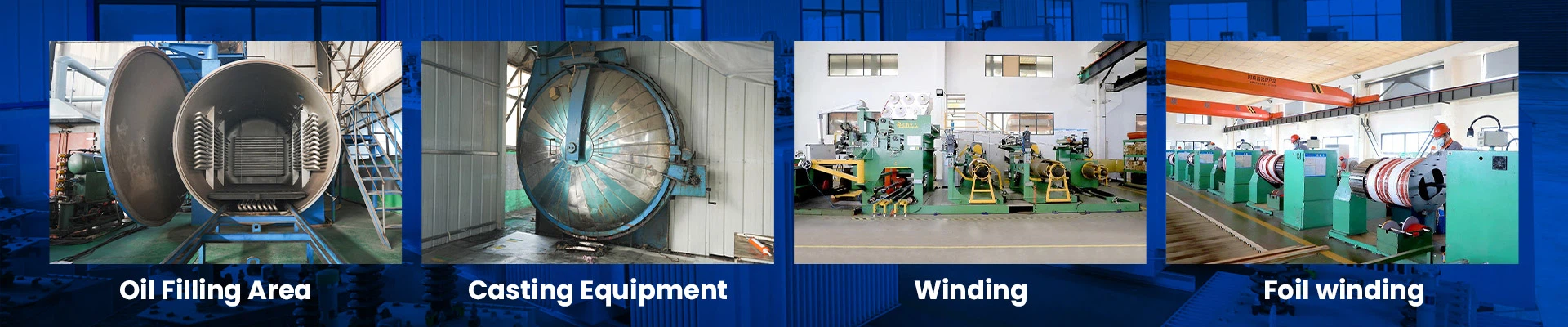
One of the defining features of a cast coil dry type transformer is the absence of liquid coolant. In our factory, we use a vacuum casting process where the high-voltage windings are completely encapsulated in epoxy resin. This creates a cast resin type transformer that is impervious to the "breathing" issues faced by oil-filled units.
Electromagnetic Stability: The resin holds the windings in a rigid structure, preventing the mechanical vibrations that cause noise and wear over time.
Dielectric Strength: The epoxy provides superior insulation, allowing the Indoor Three-Phase Transformer to handle high voltage in a much more compact frame.
Heat Dissipation: Although it is a "dry" system, the cast resin power transformer utilizes air ducts between the coils to allow natural convection (AN) or forced air (AF) cooling to carry heat away from the core efficiently.
Energy Conversion in a Low Loss Dry-type Transformer
Efficiency is the cornerstone of GNEE's design philosophy. A Low Loss Dry-type Transformer achieves high efficiency by addressing two types of energy loss: Iron Loss and Copper Loss.
Iron Loss (No-load loss): By using high-quality grain-oriented silicon steel in the dry core transformer, we minimize the energy lost through hysteresis and eddy currents within the core itself.
Copper Loss (Load loss): By using high-purity electrolytic copper or aluminum for the windings, our cast resin distribution transformer minimizes resistance, ensuring that more power reaches your equipment and less is wasted as heat.
This focus on reducing losses is why our dry distribution transformer is the preferred choice for LEED-certified buildings and green data centers where every kilowatt counts.
Component Functionality Table
| Component | Function in the 1000kVA Transformer | Material/Feature |
| Magnetic Core | Provides the path for magnetic flux | Cold-rolled grain-oriented silicon steel |
| H.V. Winding | Receives high voltage from the grid | Vacuum-cast epoxy resin encapsulated |
| L.V. Winding | Delivers stepped-down voltage to the load | High-conductivity copper/aluminum foil |
| Insulation System | Prevents electrical arcing | Class F or H non-flammable materials |
| Temperature Controller | Monitors real-time coil heat | PT100 sensors with digital display |
The Advantage of Dry Cast Resin Transformers in Urban Environments
The working principle of dry cast resin transformers makes them inherently safer for densely populated areas. Because the insulation is solid and non-toxic, there is zero risk of oil leaks polluting the groundwater or causing fire hazards in a basement or rooftop installation.
Furthermore, the cast resin distribution transformer is designed to handle "Thermal Shock." This means that when a hospital suddenly switches on high-draw equipment like an MRI machine, the transformer can handle the rapid temperature increase without the insulation cracking-a common failure point in lower-quality units.
Conclusion: Partner with a Professional Cast Resin Power Transformer Manufacturer
Understanding the working principle of a 1000kVA Dry Type Transformer reveals why it is the heart of modern electrical infrastructure. From the precision of the dry core transformer to the durability of the cast resin type transformer finish, GNEE ensures every component is optimized for performance.
As veteran cast resin dry type transformer manufacturers, we combine theoretical physics with practical engineering to provide you with a Low Loss Dry-type Transformer that stands the test of time.
Are you looking for a reliable Three-Phase Dry-type Transformer for your next project?
[SEND AN INQUIRY NOW] to speak with our technical team. Whether you need a standard dry distribution transformer or a custom-engineered cast coil dry type transformer, GNEE has the factory capacity and expertise to deliver the perfect solution directly to your site.
What is the primary role of oil in oil immersed transformers?
The oil in oil immersed transformers serves dual functions: insulation and cooling. It acts as a barrier to prevent electrical leaks and dissipates heat generated, preventing overheating and potential electrical faults.
How often should the dielectric strength test be conducted?
Dielectric strength tests are typically recommended annually or as advised by the manufacturer, aligning with operational conditions to maintain optimal transformer performance.
Why is monitoring oil levels essential for transformer maintenance?
Monitoring oil levels is crucial because low oil levels can lead to overheating and reduced insulation ability, increasing the risk of electrical faults.
What measures can prevent thermal overloads in transformers?
Preventive measures for thermal overloads include optimizing load distribution, employing advanced cooling techniques, and continuous temperature monitoring with prompt corrective actions when necessary.
How can thermal imaging help in transformer maintenance?
Thermal imaging captures infrared images to identify hotspots that may indicate electrical issues or potential component failures, allowing for early intervention and prevention of larger failures.
What makes oil transformers more efficient than dry-type alternatives
Oil transformer units achieve superior efficiency through enhanced cooling capabilities that enable higher power densities and reduced losses. The liquid insulation provides better thermal conductivity compared to air, allowing for more compact designs with improved electrical performance. Modern oil transformer designs typically achieve efficiency ratings exceeding 99%, while comparable dry-type units may have efficiency ratings several percentage points lower due to thermal limitations and design constraints.
Send Inquiry