









Power Transformer Core & Auxiliary Components Explained: Structure, Working Principle & Maintenance Guide
Apr 01, 2026
Leave a message
Ever wondered how the massive power transformers in substations keep the entire power grid running smoothly?
As the "heart" of the power system, transformers are responsible for voltage conversion, power transmission, and grid stability. But do you truly understand the mysteries of their internal core, windings, cooling systems, and critical auxiliary components?
At GNEE Electric, we specialize in high-quality power transformers and supporting components for global power projects. In this guide, we'll use professional 3D exploded views to take you through the core structure, working principles, and key functions of transformers, helping you master the technical details behind reliable power equipment.
The Core of the Transformer: Core & Windings – The Foundation of Electromagnetic Conversion
The core and windings are the "brain and muscle" of the transformer, responsible for the core electromagnetic conversion function.

Transformer Core: Made of high-quality silicon steel sheets with low loss and high magnetic permeability, it forms a closed magnetic circuit to minimize magnetic flux leakage and energy loss, ensuring efficient voltage conversion.
Transformer Windings: The primary and secondary windings are wound with high-conductivity copper or aluminum wires, insulated with high-performance materials. They realize voltage rise/drop through electromagnetic induction, and are the core carrier of power transmission.
These two core components determine the transformer's load capacity, energy efficiency, and service life. GNEE Electric uses premium silicon steel and oxygen-free copper for all transformers, ensuring low loss, high stability, and compliance with international standards such as IEC and ANSI.
Key Auxiliary Components: The "Guardians" of Transformer Safe Operation
A transformer cannot operate safely and stably without a complete set of auxiliary components. Each part plays an irreplaceable role in monitoring, protection, and maintenance:
Oil Tank & Cooling System: The "Circulatory System" of the Transformer
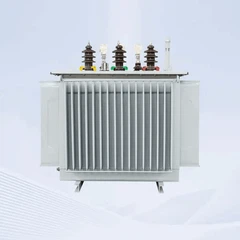
The oil tank is the "body" of the transformer, filled with transformer insulating oil that insulates, cools, and protects the core and windings. The cooling system (radiators, fans, oil conservators) relies on the thermal siphon principle to circulate oil, dissipate the heat generated by the windings, and prevent overheating damage.
- Oil Conservator: Compensates for oil volume changes caused by temperature fluctuations, ensuring the oil tank is always filled with oil.
- Radiators: Increase the heat dissipation area to realize natural or forced oil circulation cooling, suitable for different power levels and environmental conditions.
Monitoring & Protection Components: The "Sensors & Safety Valves" of the Transformer
These components are the first line of defense for transformer operation, real-time monitoring and emergency protection:
- Temperature Indicator: Uses the liquid expansion principle to monitor the top oil temperature of the transformer, with electrical contacts for over-temperature alarm and trip, preventing overheating burnout.
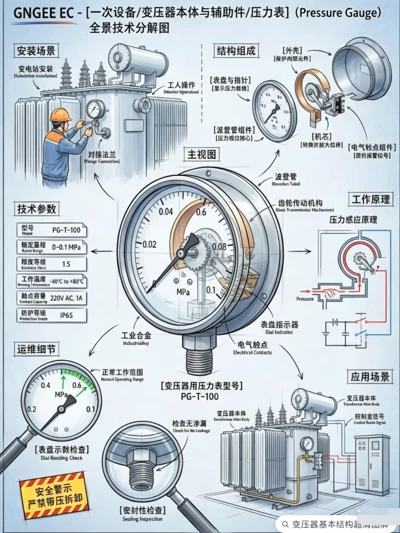
- Pressure Gauge: Monitors the internal pressure of the oil tank, triggering an alarm when the pressure is abnormal, avoiding equipment damage caused by overpressure.
- Oil Level Gauge: Adopts magnetic coupling transmission to real-time display the oil level in the oil conservator, preventing oil leakage and moisture intrusion.
- Explosion-Proof Diaphragm (Pressure Relief Device): The last safety barrier for the transformer. When the internal pressure surges due to faults, the diaphragm breaks instantly to release pressure, protecting the oil tank from bursting, and triggering an alarm signal.
- Gas Relay (Buchholz Relay): Monitors the gas generated by internal faults (such as short circuit, insulation breakdown) of the transformer, realizing light gas alarm and heavy gas trip, which is the core protection device for oil-immersed transformers.
Operation & Maintenance Components: The "Tools" for Long-Term Stable Operation
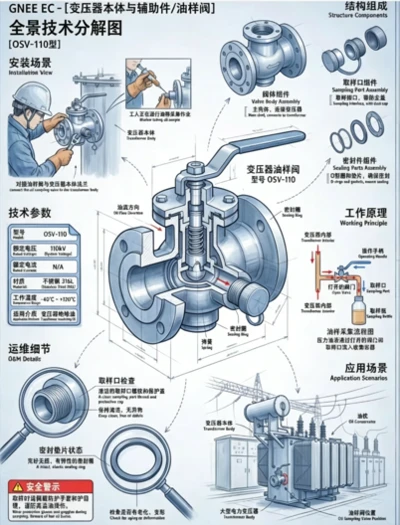
- Oil Sampling Valve: Used for regular sampling and testing of transformer oil, monitoring oil quality, moisture, and gas content, ensuring insulation performance.
- Oil Filling Hole Cover: Used for oil injection and maintenance during transformer installation, with a built-in pressure relief valve and filter screen to prevent impurities and overpressure.
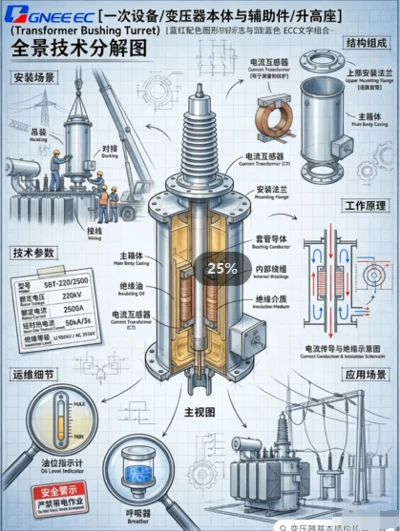
- Transformer Wheels & Bushing Turret: The wheels are used for transformer transportation and positioning, and the bushing turret is used for high-voltage lead-out, with built-in current transformers for measurement and protection.
Working Principle of Transformer: How Does the "Heart" Beat?
The operation of the transformer follows Faraday's Law of Electromagnetic Induction:
When alternating current passes through the primary winding, an alternating magnetic flux is generated in the core.
The alternating magnetic flux induces an alternating electromotive force in the secondary winding, realizing voltage conversion (the voltage ratio is equal to the turns ratio of the windings).
The insulating oil circulates through the cooling system to take away the heat generated by the winding loss, ensuring the transformer operates within a safe temperature range.
Auxiliary components such as temperature, pressure, and gas relays monitor the operating status in real time, and trigger protection actions when abnormalities occur, ensuring the safety of the power grid.
Why Choose GNEE Electric for Your Transformer Projects?
As a professional manufacturer of power transformers and supporting components, GNEE Electric has the following core advantages for global power project buyers:
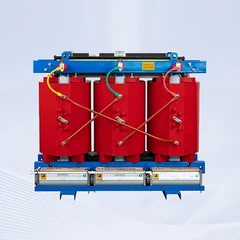
✅ Full Range of Products: From 10kV to 500kV oil-immersed transformers, dry-type transformers, to all auxiliary components (temperature gauges, pressure gauges, explosion-proof diaphragms, etc.), we provide one-stop procurement solutions.
✅ Strict Quality Control: All products comply with IEC, ANSI, GB and other international standards, with complete test reports and certifications, suitable for various harsh environments (high temperature, high altitude, coastal corrosion, etc.).
✅ Customized Solutions: We provide customized design and production according to project needs (voltage level, capacity, cooling method, protection level, etc.), meeting the special requirements of different countries and regions.
✅ Professional Technical Support: Our engineering team provides full-life-cycle technical support, from product selection, installation guidance to operation and maintenance training, ensuring your project runs stably for a long time.
Ready to Get a Custom Transformer Solution for Your Project?
Whether you are a power engineering contractor, substation EPC company, or power equipment distributor, GNEE Electric can provide you with high-quality, reliable power transformer products and solutions.
📩 Send us an inquiry now to get a free technical consultation, customized quotation, and product catalog! Our team will reply to you within 24 hours and provide the most suitable solution for your project.
Let GNEE Electric be your trusted partner in the power system, and build a stable and efficient power grid together!



Send Inquiry