


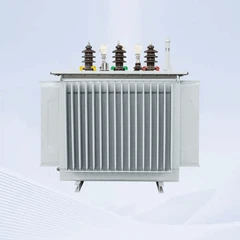






Power Transformer Working Principle, Parameters & Rating Guide
Apr 01, 2026
Leave a message
Power transformers are the core of global power transmission and distribution systems, relying on electromagnetic induction to convert voltage, current, and impedance efficiently. Understanding their working principle, rated values, and test methods is critical for correct selection, operation, and maintenance in power grids, industrial substations, and renewable energy projects worldwide.
At GNEE ELECTRIC, we engineer high-performance power transformers that meet IEC, ANSI, and international standards, tailored for diverse grid conditions in Southeast Asia, the Middle East, Africa, Europe, and the Americas. This guide breaks down the core principles, key parameters, and technical specifications of power transformers, helping you make informed decisions for your projects.
Working Principle of Power Transformers
Core Electromagnetic Induction Principle
A power transformer operates on Faraday's Law of Electromagnetic Induction:
When the primary winding is connected to an AC power source, an alternating current flows through the winding, generating an alternating magnetic flux in the iron core.
This magnetic flux links both the primary and secondary windings, inducing electromotive force (EMF) of the same frequency in both windings.
If the secondary winding is connected to a load, current flows through the load, converting magnetic energy back to electrical energy. This completes the process of transferring electrical energy from the power source to the load without changing frequency.
Transformer Turns Ratio (k)
- The induced EMF in a winding is proportional to the number of turns, defined as the transformer turns ratio k:E2E1=4.44fN2Φm4.44fN1Φm=N2N1=k
- E1,E2: Induced EMF of primary and secondary windings
- N1,N2: Number of turns of primary and secondary windings
- f: Power frequency (50Hz for China, 60Hz for North America, etc.)
- Φm: Maximum value of main magnetic flux
The current ratio is inversely proportional to the turns ratio:K1=N1/N2=k1
The winding with more turns has lower current, and the winding with fewer turns has higher current. This voltage-current conversion is the core function of the transformer.
Key Note: When the primary winding is at rated voltage, the secondary voltage varies with the load current and power factor.
Transformer Operating Modes & Parameter Testing
No-Load Operation
- Definition: The primary winding is connected to the power source, and the secondary winding is open-circuited (load current I2=0).
- Core Function: Used to measure the no-load loss, no-load current, and turns ratio of the transformer.
- Turns Ratio Calculation:U2/U1=e2/e1=N2/N1=k
Load Operation
- Definition: The primary winding is connected to the AC power source, and the secondary winding is connected to a load, with load current flowing through the secondary winding.
- Current-Voltage Relationship:K1=U1/U2=k1
In load operation, the transformer's secondary voltage drops due to the internal impedance of the windings, which is the basis for voltage regulation.
Equivalent Circuit Parameter Testing
(1) No-Load Test
Purpose: Measure no-load loss P0, no-load current I0, and turns ratio k.
Test Method: Apply rated voltage U1N to the primary winding, open the secondary winding, and read U1,U20,I0,P0. The test is usually performed on the low-voltage side for safety and instrument convenience.
(2) Short-Circuit Test
Purpose: Measure short-circuit loss Pk, short-circuit impedance Zk, and impedance voltage Uk.
Test Method: Short-circuit the secondary winding, apply a low voltage (5%~10% of rated voltage) to the primary winding, adjust the voltage until the current reaches the rated value Ik=IN, and read Pk,Uk. The test is usually performed on the high-voltage side.
Impedance Voltage (Short-Circuit Voltage)
- The voltage applied to reach rated current during the short-circuit test is called the impedance voltage, expressed as a percentage of the rated voltage:Uk%=U1N*U1k×100%=U1NI*1NZk×100%=Zk∗
Impedance voltage percentage is a key nameplate parameter, reflecting the leakage impedance voltage drop of the transformer under rated load.
Transformer Rated Values: Definition & Application
Rated values are the core technical parameters of transformers, defining their safe and efficient operating range.
Rated Capacity (SN)
- Definition: The apparent power of the transformer, the sum of three-phase capacity for three-phase transformers.
- Unit: Volt-Ampere (VA), Kilo-Volt-Ampere (kVA)
- Function: Represents the maximum power the transformer can continuously transmit under rated conditions.
Rated Voltage (UN)
- U1N: Rated voltage applied to the primary winding.
- U2N: Open-circuit (no-load) terminal voltage of the secondary winding. For three-phase transformers, it refers to the line voltage.
- Unit: Volt (V), Kilo-Volt (kV)
- Function: Defines the voltage level of the transformer, matching the power grid voltage.
Rated Current (IN)
Calculated from rated capacity and rated voltage:
- Single-Phase Transformer:I1N=U1NSN,I2N=U2NSN
- Three-Phase Transformer:I1N=3U1NSN,I2N=3U2NSN
Function: The maximum continuous current the transformer winding can carry without exceeding temperature rise limits.
Rated Frequency (fN)
- Standard: 50Hz for China, most of Europe, Asia, and Africa; 60Hz for North America, parts of South America.
- Function: The transformer is designed for a specific frequency; operating at a different frequency will cause performance degradation.
- Additional Rated Values: Efficiency, temperature rise, and insulation level under rated operating conditions are also key rated parameters.
Transformer Voltage Regulation & External Characteristics
Transformer External Characteristics
- Definition: With constant primary voltage, the curve of secondary voltage U2 changing with secondary current I2 is called the external characteristic of the transformer.
- Feature: The external characteristic curve is a slightly downward-sloping straight line. For inductive loads, the lower the power factor, the steeper the slope.
Voltage Regulation Rate
- Definition: The ratio of the secondary voltage change from no-load to full-load (I2=I2N) to the no-load voltage:ΔU%=U2NU20−U2×100%
- Typical Value: The voltage regulation rate of power transformers is generally 2%~3%, which is a key indicator of voltage stability.
Why Choose GNEE ELECTRIC's Power Transformers?
At GNEE ELECTRIC, we design and manufacture power transformers with strict compliance with international standards, tailored for global power projects:
✅ Precision Engineering: Accurate turns ratio, low no-load/short-circuit loss, high energy efficiency, reducing long-term operating costs.
✅ Global Adaptability: Support 50Hz/60Hz frequency, 10kV~500kV voltage levels, 100kVA~360000kVA capacity, suitable for diverse grid conditions worldwide.
✅ Rigorous Testing: Full factory testing (no-load test, short-circuit test, temperature rise test, etc.) to ensure compliance with IEC 60076 and other international standards.
✅ Customized Solutions: Tailor transformer parameters, connection groups, and protection devices for industrial, renewable energy, and power transmission projects.
✅ Global After-Sales Support: Professional technical team provides installation guidance, operation training, and 24/7 after-sales service.
Conclusion
Power transformers are the "heart" of power systems, and their performance directly determines the safety, efficiency, and stability of power transmission and distribution. From the core electromagnetic induction principle to key rated values and test methods, every parameter is critical for correct selection and operation.
Whether you need distribution transformers for industrial substations, large power transformers for transmission projects, or special transformers for renewable energy, GNEE ELECTRIC delivers reliable, efficient, and customized solutions.
Send Inquiry