









What Is The Historical Development Of Transformers?
Feb 14, 2025
Leave a message
What is the historical development of transformers?

Early development stage
The invention of the transformer can be attributed to the British physicist Michael Faraday, who discovered the principle of electromagnetic induction in 1831 and verified this principle through experiments. In 1837, the British Masson used thin iron sheets as the core of the electromagnetic coil to reduce losses. In 1881, the Frenchman Jaewin discovered the hysteresis phenomenon, which further promoted the development of transformer technology.
Practical stage
In 1882, the British Goulard and J.D.Jibbs manufactured the first 15kVA, 1.5kV open-core single-phase transformer. In the same year, S.Z.Ferranti and A.Tomson invented the current transformer. In 1884, Hungarians O. Blathy and M. Dery built a 1400 VA, 120/72 V, 40 Hz single-phase closed magnetic circuit transformer, marking the practical application of transformers.
Technological innovation stage
With the growth of material science and electricity demand, the technology of transformers has continued to advance. At the end of the 19th century, the core of the transformer was made of E-shaped iron sheets, and it began to be used commercially in 1886. In the early 20th century, American engineer William Stanley built the first practical transformer, which promoted the widespread application of transformers.


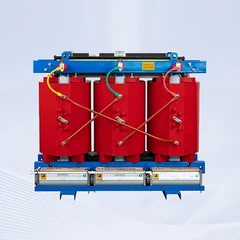
| Dry type transformer |
development trends
Modern applications and development trends
In the 20th century, the application range of transformers continued to expand. In 1904, J.A. Fleming of the United Kingdom invented the vacuum diode, which promoted the application of rectifier transformers in electronic circuits. In the 1920s, the rise of radio broadcasting led to the widespread use of small power transformers and audio transformers in radios. With the development of science and technology, power transformers have begun to develop in the direction of intelligence and environmental protection, realizing remote monitoring and automatic adjustment through built-in sensors and control systems, while adopting low-noise design and oil-free technology to reduce environmental impact.
Modern applications
Modern power transformers are not only constantly innovating in materials, structures and cooling technologies, but also adapting to the needs of renewable energy access and power system intelligence.
 Dry type Transformer


Send Inquiry