


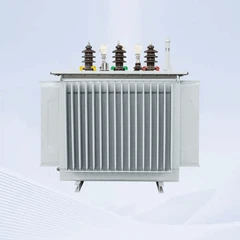
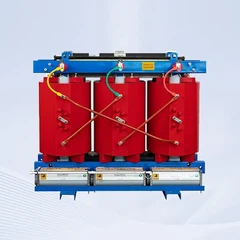





100kVA Three Phase Oil Type Earthing Transformer
Nov 18, 2025
Leave a message
A 100 kVA transformer is an electrical device used to step up or step down voltage levels in power distribution systems, ensuring efficient energy transfer.With a capacit yof 100 kilovolt-amperes, it is commonly employed in commercial or industrial settings to supply power to equipment, lighting, or machinery. This transformer operates by electromagnetic induction, featuring primary and secondary windings to adjust voltage while maintaining power stability. lts compact design, reliability, and ability to handlemoderate loads make it ideal for applications like small factories, office buildings, or renewable energy systems, enhancing electrical efficiency and safety.
This 100 KVA 11KV transformer was delivered to Guatemala in 2024. the rated power of the transformer is 100 KVA. It is a Step-down transformer 11KV to 0.38KV, the primary voltage is 11KV, the secondary is 0.38KV. The transformer is equipped with ±2*2.5% no load tap changer at primary side. Our 100 KVA Distribution Transformer was designed with advanced technology and adopts high quality material and components which result in reliable quality and long operation time.
100 KVA transformer load capacity and specification.
|
Delivered to |
Guatemala |
|
Year |
2024 |
|
Model |
S11-100 KVA-11/0.38KV |
|
Type |
Oil Immersed Distribution Transformer |
|
Standard |
IEC60076 |
|
Rated Power |
100 KVA |
|
Frequency |
60 HZ |
|
Phase |
Three |
|
Cooling Type |
ONAN |
|
Primary Voltage |
11 KV |
|
Secondary Voltage |
0.38 KV |
|
Winding Material |
Copper |
|
Vector Group |
Dyn11 |
|
Impedance |
4% |
|
Tap Changer |
NLTC |
|
Tapping Range |
±2*2.5% |
|
No Load Loss |
0.5kw |
|
On Load Loss |
1.5kw |
|
Accessories |
Standard Configuration |
|
Remarks |
N/A |
Main Component of 100 KVA 11/0.38KV Transformer
Main Component of 100 KVA 11/0.38KV Transformer

Core:
The iron core is one of the most basic components of the transformer, and it is the magnetic circuit part of the transformer. The primary and secondary winding of the transformer are all on the iron core. In order to improve the magnetic permeability of the magnetic circuit and reduce the eddy current loss in the iron core, the iron core is usually made of 0.35mm silicon steel sheet with insulating surface. The iron core consists of two parts, the iron core column and the iron yoke. The winding are put on the iron core column, and the iron yoke connects the iron core to form a closed magnetic circuit.

Winding:
The winding is also one of the most basic parts of the transformer. It is the circuit part of a transformer, usually made of copper or aluminum wire wrapped in insulating paper. The winding connected to the high-voltage network is the high-voltage winding, and the winding connected to the low-voltage network is the low-voltage winding.

Transformer leads:
1. Transformer leads have three requirements: (electrical performance), (mechanical strength) and (temperature rise requirements).
2.The power transformer leads are (bare copper wire), (paper-wrapped round copper wire), (bare bus bar), (cable) and (copper tube), etc.
3. Our factory adopts lead connection method (brazing) (gas welding) (cold pressure welding) (mechanical connection).

Oil Tank:
The basic functions of transformer oil tank can be summarized as protection of oil tank and holding oil, installation skeleton of external components and heat dissipation.
Finished 100 KVA 11/0.38KV Transformer

How to Calculate the Required KVA Rating for three Phase Transformers?
A transformer is used to convert the incoming voltage at the location to the correct voltage for the electrical device (the submersible motor in case of ESP). Transformer selection is based on mainly 4 parameters:
Power rating in KVA (Kilo Volt Amperes),
Primary voltage,
Secondary voltage,
Tap arrangement.
In this post, we'll detail how to calculate the required KVA for a 3 phase transformer. Actually, The calculation of KVA capacity for a Three Phase Transformer is based on Winding Voltage and Amperage information. The simple formula to calculate the rating of three phase Transformers is:
KVA = (√3. V x I) /1000
Where: V is the voltage (volts) and I is the current (amps).
Example:
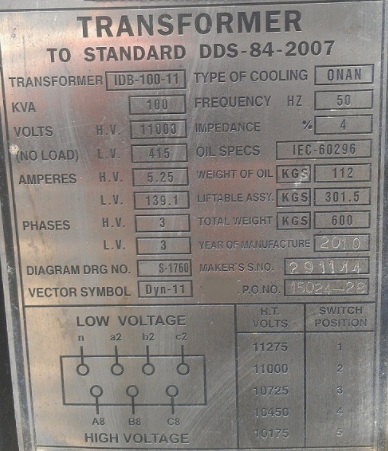
the following figure presents a nameplate of a three phase transformer. It's rating is 100 KVA. Using the aforementioned formula, let's confirm this rating:
Primary Voltages or High Voltages (H.V) is 11000 volts.
Primary Current (current on High Voltage side) is 5.25 amps.
KVA = (√3. V x I) /1000= (1.732 × 11000 × 5.25)/1000=100 KVA
Similarly:
Secondary voltages or Low Voltages (L.V) is 415 volts.
Secondary Current (Current on Low voltages side) is 139.1 amps.
KVA = (√3. V x I) /1000= (1.732 × 415 × 139.1)/1000=100 KVA
This leads to the fact that the KVA rating of a transformer is the same for either the primary or secondary.
(KVA)in = (KVA)out
What is the load capacity of a 100 kVA transformer?
100 KVA transformer load capacity in kW
with the average power factor of 0.8 calculation,a 100 KVA transformer can provide (100 KVA × 0.8) 80 KW active power for the load.
What does 100va mean on a transformer?
VA stands for volt-amperes. A transformer with a 100 VA rating, for instance, can handle 100 volts at one ampere (amp) of current. The kVA unit represents kilovolt-amperes, or 1,000 volt-amperes.
How many kW are in 100 kVA?
80 KW
How to Convert KVA to KW?
| Power Factor (PF) | 0.5 | 0.8 |
|---|---|---|
| 100 KVA | 50 KW | 80 KW |
| 150 KVA | 75 KW | 120 KW |
| 200 KVA | 100 KW | 160 KW |
| 250 KVA | 125 KW | 200 KW |
How many houses can a 100 kVA transformer handle?
Transformer Sizing Reference Table (Estimates Only)
| Transformer Size (kVA) | Small Home / Apartment (~3-5 kVA Peak) | Standard Suburban Home (~7-12 kVA Peak) |
|---|---|---|
| 25 kVA | 4 - 8 | 1 - 3 |
| 50 kVA | 8 - 15 | 3 - 6 |
| 100 kVA | 20 - 30+ | 8 - 12 |
| 500 kVA | 100 - 150+ | 40 - 60 |
How many kVA can power a house?
The KVA of a Generator Required To Run Your Home Comfortably; For an average home, the required KVA should be at least 3 KVA to 5 KVA. With this power in a generator, you will comfortably be able to run all your household appliances.
How many amps is 100 kVA 3 phase?
Table of kVA to Amps Conversions
| kVA | Voltage (V) | Amps |
|---|---|---|
| 100 | 240 | 520.83 |
| 200 | 240 | 1041.67 |
| 300 | 240 | 1562.5 |
| 400 | 240 | 2083.33 |
How many kVA is 3 phase?
No further rounding or conversion is needed, since 30 KVA is a standard three-phase transformer size.
How do I test the practical load capacity of a 100kva transformer?
You would perform a load capacity test where you load the primary and secondary windings to full load current, allow the winding (copper) losses to heat the transformer for a time sufficient for the thermal mass to reach a steady state temperature rise at the winding hot spot. The results are then corrected to account for the core and excitation loss. If the hot spot rise is below the rated rise, the transformer will pass the test.
At the transformer factory, they will perform a load capacity test if requested by the customer. This test is expensive because it lasts a long time and uses a large amount of energy.
The limiting factor of the loading capacity of a transformer is the temperature rise. For large power transformers, they have a very high heat capacity due to their large metal tanks filled with mineral oil, large iron cores and windings coils. All this mass has a tremendous capacity to store thermal energy and that is why the test can take a long time to perform.
The transformer is not subjected to full rated voltage during the test. Rather, a short circuit is placed on the low voltage winding while a voltage source is used to excite the high voltage winding. The voltage source is increased to the point where rated current flows in the high voltage winding. Because of this, the test does not directly account for temperature rise due to rated voltage excitation and core loss. Transformer manufactures will adjust (or correct) the results to include excitation and core loss so that the load capacity will better approximate actual loading at rated voltage.
Load capacity tests are also known as heat run tests.
What is the maximum capacity load for a 100kv transformer on 11kv line?
If the transformer is 100 KVA , and it's primary is 11 KV , and assuming secondary is 400 V .
Then Rated Secondary current - assuming no losses- = 100000/1.73*400 = 144.5 A
How do you calculate the primary current of an 11kv/440v 100kva transformer?
The formula for 3 phase apparent power is S=1.732*V*I, where V and I are the line voltage and line current respectively. When the given transformer is supplying 100kva of apparent power to the load then for the primary side of the given transformer, S=100kva , V=11kv and I is to be calculated. So by rearranging the equation given above I can be expressed as I =S/(1.732*V). In this case the primary current of the transformer while supplying 100kva of apparent power comes out to be 5.25Amps.
Send Inquiry