








How Much Does a 200MW/400MWh Standalone BESS Cost in 2026?
Oct 19, 2026
Leave a message
Key takeaways - the short answer
- A 200MW/400MWh standalone BESS costs RMB 0.81–1.35 per Wh (USD 113–189 per kWh) on an EPC basis in 2026 - roughly USD 45–76 million for the full plant. The 60%+ spread is not a pricing error; it comes from what happens outside the battery container.
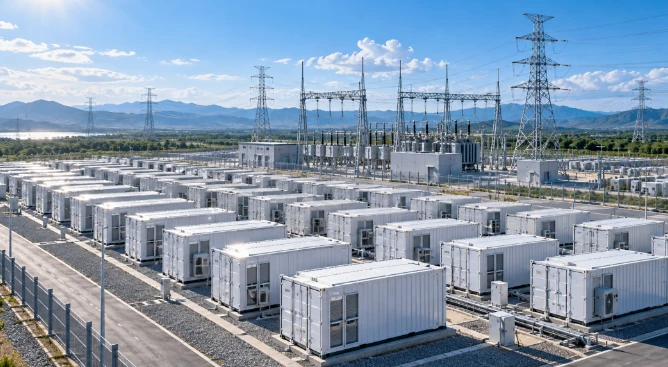
- 200MW/400MWh = a 2-hour (0.5C) system holding 400,000 kWh - one full discharge covers a day of electricity for about 40,000 households.
- Equipment is 63.9% of EPC cost, civil works and installation 19.8%, land / grid connection / management 11.7%, contingency 3.7%, design and survey 1.0%.
- LFP cells are 55–65% of system equipment - about one-third of total plant CAPEX. The largest single line item, but not the majority of the bill.
- Three "outside-the-box" factors move the price by up to RMB 0.54/Wh (USD 76/kWh): distance to the grid substation, new vs. extended step-up substation, and site earthworks.
- Cell prices turned in 2026. 314Ah LFP cells rose from RMB 0.31/Wh (late 2025) to RMB 0.37–0.40/Wh (mid-2026), while IGBT, copper and aluminium rose 30–200%. Costs are going up while EPC bids keep falling.
- Two costs sit outside the construction budget: annual O&M at 1–2% of equipment value, and one battery replacement around year 8 at roughly RMB 1.00/Wh (USD 140/kWh) - about USD 56 million on a 400MWh plant.
Currency note: all USD figures are converted at an indicative rate of USD 1 = RMB 7.15. Unit conversion: RMB 1.00/Wh = USD 140/kWh.
What "200MW/400MWh" actually means
MW and MWh are the two numbers everyone quotes and the two numbers most often confused.
- MW (megawatt) is power - how fast the plant can discharge.
- MWh (megawatt-hour) is energy - how long it can sustain that discharge.
Divide one by the other and you get duration: 400MWh ÷ 200MW = 2 hours. In industry shorthand this is a 2-hour system, also written as 0.5C. It is the same C-rate as the common 100MW/200MWh configuration, simply doubled in scale - and it is the configuration that appears most often in 2025–2026 storage tenders.
Translated into electricity: 400MWh is 400,000 kWh. At an average household consumption of 10 kWh per day, one full discharge at rated power covers 40,000 homes for a full day.
Why is 2 hours the mainstream duration?
Because in most provincial tariff structures the high-price peak window lasts only 2–4 hours in the evening. A 2-hour system covers the most profitable arbitrage slot at the lowest capital outlay per cycle. Storage duration is designed against the tariff curve, not picked at random - which is why 4-hour systems are appearing only where capacity payments or renewable-shift requirements justify the extra cells.
Small Tip
Duration is an output of the tariff curve, not a technical preference. Before you specify 2, 3 or 4 hours, pull the actual peak/off-peak spread for your market: if the paid arbitrage window is under 2 hours, every extra hour of cells is capital that never cycles enough to recover.
Where the money goes: the four blocks of an EPC price
Standalone storage plants are normally delivered under EPC (engineering, procurement, construction) - the owner pays one sum and the contractor takes the project from design through procurement, construction and grid connection.
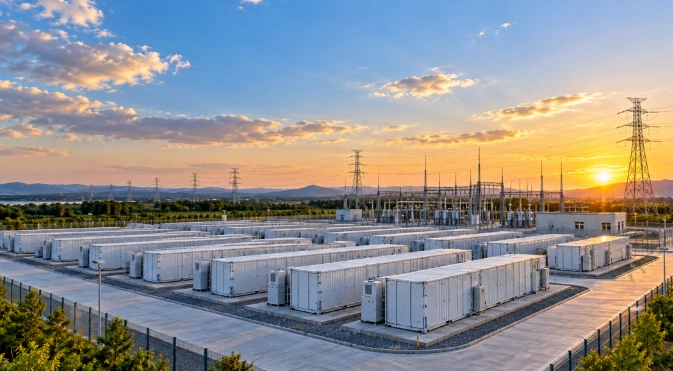
The most useful public reference available is the control price published for a 200MW/400MWh project in Lishi District, Shanxi (August 2026): RMB 424 million total, equal to RMB 1.06/Wh:
| Cost block | Share of EPC | RMB (million) | USD (million) | What it covers |
|---|---|---|---|---|
| Equipment procurement | 63.9% | 271.0 | 37.9 | Battery containers, PCS, main transformer, switchgear |
| Civil works & installation | 19.8% | 83.9 | 11.7 | Site levelling, foundations, cranage, collector lines, export line |
| Other costs | 11.7% | 49.6 | 6.9 | Land acquisition, grid interconnection, project management |
| Contingency reserve | 3.7% | 15.7 | 2.2 | Unforeseen expenditure |
| Design fee | 0.8% | 3.4 | 0.47 | Engineering design |
| Survey fee | 0.2% | 0.9 | 0.12 | Geotechnical investigation |
| Total | 100% | 424.0 | 59.3 | = RMB 1.06/Wh ≈ USD 148/kWh |
Equipment takes nearly two-thirds of the budget - but the 19.8% installation block is not small change. It carries site levelling, concrete foundations, equipment lifting, and the towers and conductors of the export line. Every extra kilometre of export line can add several million RMB to this line.
Small Tip - the trap
This control-price basis normally excludes land transfer fees, construction-period interest, and the O&M reserve fund. True all-in project investment is always higher, and the uplift depends entirely on how the land is secured and how the project is financed. Never apply a fixed percentage to "gross up" an EPC price - each project has to be calculated on its own terms.
Inside the container: cost is layered, and cells are only a third of the plant
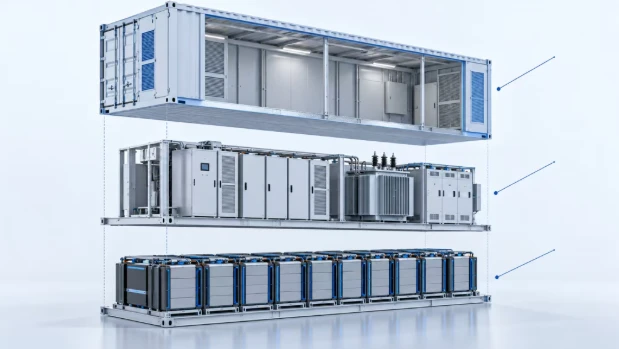
The 64% equipment block is itself a black box. Peeling it open from the enclosure inward:
| Layer | Share of system equipment | Function |
|---|---|---|
| LFP cells / battery system | 55%–65% | Stores the energy |
| PCS (power conversion system) | 10%–15% | DC ↔ AC conversion |
| BMS (battery management system) | 5%–9% | Monitors and protects every rack |
| EMS (energy management system) | ≈ 2% | Decides when to charge and discharge |
| Thermal management (liquid cooling) | 5%–7% | Controls temperature, slows degradation |
| Enclosures, cabling, busbars, integration | Remainder | Container, assembly, balance of system |
Cells are the most expensive single item in the plant, without competition. They are the energy carrier, take more than half of system equipment, and work out to roughly one-third of total installed cost.
Identical specification, quotes 60% apart
Comparing tender results for the same 200MW/400MWh configuration in 2026 produces this spread:
| Project | Status | RMB / Wh | USD / kWh | Plant total (USD) |
|---|---|---|---|---|
| A EPC | Winning candidate | 0.81–0.82 | 113–115 | 45.3–45.9 M |
| B EPC | Tender control price | 1.06 | 148 | 59.3 M |
| C EPC | Winning candidate | ≈ 1.29 | ≈ 180 | ≈ 72.2 M |
| D EPC | Awarded | ≈ 1.30 | ≈ 182 | ≈ 72.7 M |
| E EPC | Tender control price | 1.35 | 189 | 75.5 M |
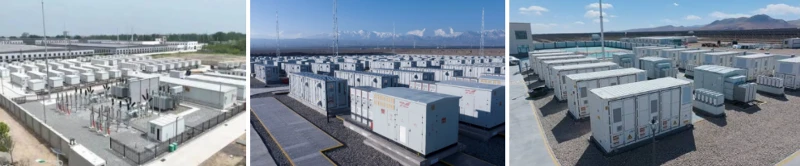
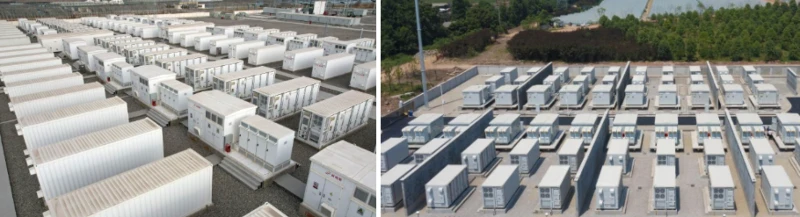
Nobody miscalculated. The unit of comparison is wrong: the differences are almost entirely outside the container.
- Grid distance. A site 4 km from the substation versus 30 km changes export-line cost by an order of magnitude.
- Step-up substation. Building a new substation versus extending an existing bay is a completely different investment class - this is where main transformers, MV switchgear and reactive-power compensation enter the bill.
- Site condition. A levelled industrial park versus a site needing heavy cut-and-fill directly resets the civil budget.
Small Tip - before you believe any price
When you see a headline such as "storage EPC breaks USD 98/kWh (RMB 0.70/Wh)", ask: how long is the export line; is the step-up substation new or an extension; is any existing grid infrastructure being shared? Without those three answers the comparison is meaningless - and so is the IRR you build on top of it.
The 2026 turn, plus two accounts that never appear in the construction budget
Everything above assumed one thing: costs are falling.
In 2026, that assumption no longer holds.
- LFP cells. The mainstream 314Ah cell moved from RMB 0.31/Wh (late 2025) to RMB 0.37–0.40/Wh (mid-2026) - a cumulative increase above 20% that ended 18 months of one-way decline. CATL's online store listed 314Ah cells from RMB 0.403/Wh in September 2026.
- PCS. Centralised unit prices rose from RMB 0.064/W to RMB 0.068/W.
- Upstream. Copper, aluminium, silver and tin rose 30%–200%; PCBs and IGBTs rose by more than half. The IGBT is the key power device inside the PCS - when it rises, converters follow.
The result is an uncomfortable scissors: input costs rising while EPC bids keep being squeezed down. That gap cannot persist indefinitely.
Small Tip - do not model on the lowest number
Building an IRR on USD 105/kWh (RMB 0.75/Wh) is high-risk. Equipment alone compresses to around RMB 0.60/Wh; add the step-up substation and civil works and a genuine below-cost bid is usually being carried by extended payment terms, weakened warranty clauses or a land-grab for market share. Model on the three-month weighted average of comparable projects, not the lowest bid.
How to sanity-check any BESS quote in six steps
- Convert to a common basis. RMB/Wh or USD/kWh? EPC, equipment-only, or all-in? Normalise to USD/kWh of installed energy and state whether land, interest and grid connection are inside.
- Split equipment from balance of plant. Expect equipment at 60–65% of EPC. If a quote is 80% equipment, the civil and grid scope is being hidden somewhere else.
- Check the cell share. Cells at 55–65% of equipment means roughly one-third of total plant CAPEX. Much higher and the rest of the plant is under-specified.
- Pin down the three outside-the-box variables. Export line length, new vs. extended substation, earthworks volume - in writing.
- Re-price against the last three months. Use the weighted average of comparable 2-hour projects, not the record low. In 2026 the cell curve has already turned.
- Add the operating decade. O&M at 1–2% of equipment value per year, plus one battery replacement at year 8. Then calculate LCOS - not CAPEX/kWh.
The three lines to remember
Equipment dominates, and cells are the undisputed single-item champion at about one-third of total plant investment.
Outside-the-box cost varies enormously - the step-up substation and export line alone account for a USD 76/kWh spread between projects of identical size.
The real money is in the operating decade: O&M and battery replacement are not in the construction budget, but they decide whether the project ever earns.
Next time a storage bid price crosses your desk, read it along those three lines: what is the equipment share, what are the grid-connection conditions, and has the year-8 battery replacement been provisioned.
Get a costed configuration for your project
A per-kWh number is only useful once it is attached to your grid conditions, your tariff curve and your duty cycle. GNEE Electric engineers the electrical package around a BESS - containerised and pad-mounted step-up substations, MV switchgear, distribution panels, protection and metering, and integrated step-up-conversion skids - and prices it on the same basis as your battery scope, so the comparison is real.
Send us your single-line diagram, grid-connection point and target duration. You receive a configured equipment list with indicative pricing, delivery schedule and compliance documentation (IEC / IEEE / GB as applicable) - typically within 3 working days.
fAQ
How much does a 200MW/400MWh BESS cost per kWh in 2026?
On an EPC basis, RMB 0.81–1.35/Wh, equal to USD 113–189/kWh, or roughly USD 45–76 million for the complete plant. The range is driven by grid-connection distance, substation scope and site conditions rather than by battery pricing alone.
What percentage of a BESS is the battery?
LFP cells are 55–65% of system equipment, and system equipment is about 64% of EPC. Net effect: cells are roughly one-third of total plant investment. The remaining two-thirds goes to PCS, transformers, civil works, collector lines and grid connection.
Why do two 200MW/400MWh projects differ by more than 60% in price?
Because the comparison is usually made on the container, while the spread is created outside it - export-line length, new versus extended step-up substation, and earthworks. A 30 km line and a greenfield substation can add USD 76/kWh to an otherwise identical plant.
When should a battery be replaced in a 400MWh BESS?
Industry convention is around year 8 under frequent cycling, at approximately RMB 1.00/Wh (USD 140/kWh) - about USD 56 million for 400MWh. This must be provisioned in the original financial model.
Send Inquiry